An office full of nurses and no antiseptic wipe

Maximus hanging figures

Yesterday I accompanied someone to his Work Capability Assessment. Let’s call him Jack. Jack had one of those lists of ailments that spill off the form onto further pieces of paper, and quite clearly should never have been called in at all. And he already had serious mobility problems before having a toe amputated four days earlier. He arrived by taxi with his mother and had to walk slowly, leaning on a stick and steadying himself on her arm. Although there is parking in front of the assessment centre, this is only for the people who work in the building and it is protected by a barrier. The taxi had to stop the other side of the barrier, and Jack had to make his way slowly across the parking area. To someone in good health, the distance from barrier to door, across the outer lobby and down the corridor might not seem much, but the people coming to the centre are not in good health. Jack struggled, and half way down the corridor he fell full length on the floor. Slowly, he managed to get up and make it the remaining distance to the waiting room. When he was at last sitting down he rolled up his trouser leg and found he had a raw red graze on his knee. I asked the receptionist for an antiseptic wipe and he said they didn’t have anything. I pointed out that every workplace has a legal requirement to have a first aid box, but he was unmoved. I pointed out that we were in an office full of nurses, but he was equally unimpressed, as was the nurse who had come into the office behind him. If the graze had been worse I would have been more insistent, but I didn’t want to antagonise them before the assessment had even begun. I was not optimistic when I found that it was the nurse we had seen earlier who was doing the assessment; but not long after she had started her questions, Jack produced a crumpled sheet of notes from his doctor. She took it away and when she came back she told us she didn’t need anything further. They had only called him in because his doctor had not sent them information when they had requested it!

The assessments are run by multi-national private company, Maximus, who took over from ATOS. The parody of the Maximus logo I have used above was drawn by activist illustrator Phill Evans, but the original, below, is not much better: ordinary folk holding up their fancy roof. Was the designer trying to make a point?

Maximus-Inc.-logo

£slavestretcher

There are some businesses that thrive on poverty, and Poundstretcher is one of them. Poor people shop there because it is cheap – and one reason it can be so cheap is that people are forced to work there for free or lose their benefits, under the DWP’s Mandatory Work Activity scheme: probably some of the same people who they rely on as customers.

IMG_1370

Last week one of our SUWN activists was told to report to Poundstretcher in Dundee this morning, along with a group of around 8 other people on JSA. He was not happy, and yesterday he delivered a letter to Learndirect who arranged the placement. This made clear that it was not reasonable, even in their own terms, to expect a skilled IT engineer who had been unemployed only 9 weeks to do a placement designed to ‘develop disciplines associated with employment’. It also pointed out that stacking shelves at Poundstretcher does not comply with the Mandatory Work Activity Provider Guidance requirements that placements are of ‘community benefit’ and ‘not at the expense of employing workers in the open market’. Poundstretcher serves no community function, and their employees have been refused a request for more hours. However it was made clear to him that if he didn’t turn up he could be facing a 13 week benefit sanction. So, this morning, he duly checked in – and we duly set up a protest with banners and chants outside the gates.

IMG_1375It seems that yesterday’s letter made them rethink their plans. No other DWP slaves were there, so we can only assume that their start was rescheduled so that they weren’t corrupted. As others have done before, our activist refused to sign the documents he was given by Poundstretcher – which they can’t make you do. He was then told he should leave. We wait to see what happens next, but he will probably be sent a letter by the DWP and will have to make it clear that he participated fully in all that was asked – he just didn’t sign the papers.

Poundstretcher staff called the police, but this time the police seem to have had the sense not to come out to a perfectly legitimate protest. We did have a reporter from the local paper though, so we hope that more people will see how the UK is developing a third class labour force, paid only on benefits, and undercutting even minimum wage jobs. Perhaps the other potential DWP slaves will hear about the protest too.

The one sour note was from an angry member of staff who wasn’t interested in why we were there and only wanted to tell us that his poor working conditions were the fault of ‘immigrants’. We still have a lot to do to counter the tabloid propaganda.

No-one puts it better than Kevin Bridges – so for youse who haven’t already seen it, and even if you have, here’s his take on workfare at Pounstretcher.

Normalising unpaid labour

Over the last 2-3 months, the Dundee stalls have been pretty quiet with only a trickle of inquiries, but we have noticed an upturn in inquiries and live issues in the last couple of weeks. At today’s stall we came across a number of people who had major complaints regarding the way they had been treated.

An older blind gentleman had been told that he was required to pay back an overpayment of benefits, but claimed that he had already been paying back this overpayment from November last year. We urged him to approach his support worker in order that he can be referred to a welfare rights organisation to act on his behalf.

Although sanction issues have appeared to have largely dried up, we came across one guy who had been sanctioned for 13 weeks for failing to take part in a ‘Mandatory Work Activity’ (MWA). Although this scheme, according to the DWP’s own guidelines, is meant to involve people taking positions in organisations such as third sector, charity and environmental agencies, and any work they do is meant to be of demonstrable benefit to the community, the guy we spoke to had refused to participate because he was being asked to stack shelves in Poundstretcher. (This is not to say that it is OK to make people do ‘community’ work unpaid – particularly ‘environmental’ work, which generally means sorting through rubbish.)

We also came across a woman who was long-term unemployed, and who had been through a two year Work Programme (WP) placement, and who had just finished a four week MWA. She is on the ‘Help to Work’ scheme, which is the next stage for people who have already completed the WP. Her JC advisor told her that she would be enrolled on a DWP training course, but when she pointed out that any training would be of limited use to her due to her literacy problems, the advisor reassured her that ‘it was not that kind of course’ and that she would simply be asked to hang clothes on hangers in a retail outlet. The woman responded by asking ‘how is that training?’ and also pointed out that any referral to a ‘training scheme’ would mean that she would miss the voluntary work and courses she is already signed up to, on her own account. She is currently enrolled in a job club, volunteers in a nursery and is on courses for her literacy problems. She reported that the advisor was completely dismissive of her initiative and expected her to drop everything in order to take up the placements and ‘training’. We advised her to contact us so that we can accompany her in to her next meeting in order to help her challenge this high handed attitude.

The major issue we are being approached about is Workfare in its various guises – it is quite clear to us that the roll out of mandatory work schemes is being accelerated, to the extent that some who actually sign up to these schemes are having to wait weeks before they are given a placement. We can only see this issue coming even more to the fore in the coming weeks and months, and we are preparing for a lot of hard campaigning. This is, however, an issue that not only affects the unemployed – if Workfare is allowed to bed in, and to spread, it will represent nothing more nor less than the normalisation of ‘unfree labour’ within British society. How long before any prospective employee is expected to undergo months, or perhaps even years, of working for their ‘benefits’ before they are actually paid for work? The trade unions need to wake up to the dangers posed by Workfare, to their members, and, indeed, to the very existence of the trade unions as meaningful organisations able to defend employment rights.


The need for an Anti-Austerity Covenant

SUWN activists joined this morning’s anti-cuts march in Dundee. The statement below is from our leaflet:

IMG_1304Tory cuts have decimated local authority services, and the next two years are set to see a further £40 million cut from Dundee City Council funding. It appears that all we can expect from Cameron and the current Eton set who dominate British establishment politics is perpetual Austerity. We therefore applaud and support the call, made by Dundee City Council shop stewards committee, that councillors should vote against further cuts at the upcoming budget, and that, instead, councillors should draw on reserves and borrowing in order to guarantee a ‘no cuts’ budget in the short term. We do, however, realise that such a tactic is not, by itself, enough, and may only delay the implementation of further cuts. In order to protect Scottish, and British, society from  further swingeing cuts, a broad based movement encompassing Scottish civil and political society has to be mobilised, comprising the trade unions, political parties, community and welfare groups, local councils and the Scottish government. Such a broad based alliance could act as ‘rod of iron up the back’ of the Scottish government in opposing, by every means necessary, any further attempts to impose Austerity on communities that are already reeling as a result of thirty to forty years of neo-liberalism and de-industrialisation.

Divisions still exist within the Scottish left in the wake of the 2014 Indyref, particularly within the trade union movement, which is why be believe it is necessary to build a new Scottish Covenant on the basis of a minimum programme of demands that all sections of Scottish progressive and left opinion  can unite around.

Our fundamental – and minimum – demand is that all aspects of Scottish welfare provision and employment law should be under the control of Holyrood, because we cannot trust Westminster to look after the interests of the most vulnerable elements within Scottish society. We understand fully the very real barriers to the success of such a strategy, but we also understand the urgent necessity of fighting back against the present Tory attempt to bring the Thatcherite revolution to full fruition. If those at the sharp end of Austerity, representing the majority of working people as well as the unemployed and disabled, do not unite and fight then this generation surely deserves the terrible consequences that will follow – a hollowed out welfare state, a low wage, and even no wage, low skill economy and an increasingly authoritarian British state.

The reluctance of the current Tory government to further devolve welfare provision derives from the fact that a fully devolved Scottish welfare state would provide the ‘threat of a good example’, which would lead to mounting demands for an abandonment of Austerity throughout the rest of the (dis)UK. Further than this, to stand any chance of success, the Scottish anti-austerity Covenant would need to look outwards and forge links with progressive, left and civic groups and movements in the other nations and regions of the British Isles, including the TUC, Corbyn’s Labour Party, the Greens and Plaid Cymru.

When politicians make serious progressive change it is in response to pressure from below that makes it impossible for them to continue to compromise everyone’s future. If such a broad alliance could be constructed, the Scottish government, bolstered by a mobilised anti-austerity movement, could well be pushed into a major face-off with Westminster over their refusal to implement the Tory Austerity programme, thereby laying the basis for a serious and unprecedented British constitutional and political crisis that could pave the way for positive political and economic transformation.


A New Basic Income Network for Scotland


A new Basic Income network is in the process of being set up. We will include a connection to their website when it is available, but if you want to be kept in touch with progress please email anniemillerBI@gmail  to be added to their mailing list. Meanwhile, you can read Annie Miller’s article on Basic Income in our May 2014 Newsletter, and here is the network’s

POLICY STATEMENT AND OUTLINE WORK PLAN

Vision: a fairer, more just society, where every citizen receives a Citizen’s Basic Income.

The Mission of the Citizen’s Basic Income Network Scotland is

‘to advance research and public education about the economic and social effects and influences of Citizen’s Basic Income systems (defined here as schemes which guarantee an unconditional, non-withdrawable income payable to every individual as a right of citizenship)’.

A Citizen’s Basic Income (CBI) would provide every citizen with a universal, non-means-tested and unconditional basic income, replacing most of the current Social Security benefits and most of the current tax loopholes in the personal income tax system.  Each feature of CBI can help to achieve several related objectives of welfare reform and wider social and economic policy, in the areas of:

  • individual empowerment and choice;
  • labour market efficiency;
  • greater administrative simplicity;
  • the creation of a fairer, more supportive and inclusive society;
  • prevention of poverty, and
  • a reduction in inequality of income.

The more generous the scheme, the greater will be the potential fulfillment of these objectives.

The role of Citizen’s Basic Income Network Scotland is to educate the general public, policy- and decision-makers about the desirability and feasibility of CBI schemes.  Although the concept itself is relatively simple, implementation is fairly complex and technical.  There is no single optimum CBI scheme.  However, the better informed the public, the more likely they are to persuade decision-makers to establish a suitable CBI scheme for the benefit of society.

Citizen’s Basic Income Network Scotland will work to build awareness and support for CBI in Scotland, although full implementation would only be possible with devolution of full fiscal powers to the Scottish government.

During 2015 the four founder trustees prepared the setting up of Citizen’s Basic Income Network Scotland including the preparation of our application for charitable status.   During 2016 we will

  • set up a business bank account;
  • start to raise funds;
  • set up a website and create a blog;
  • recruit more trustees;
  • recruit volunteers to help with our work;
  • establish a contacts database;
  • support publication of a CBI Handbook, written by Annie Miller;
  • plan the launch and promotion of Citizen’s Basic Income Network Scotland.

We plan to launch Citizen’s Basic Income Network Scotland in the spring of 2016 with the publication of the new book on CBI by Annie Miller, which will be promoted through a media release and other public relations activity.

Following its launch, the trustees of Citizen’s Basic Income Network Scotland will develop its profile, reach and impact through:

  • tailored communication for different audiences, occasions and media, including talks at events, to build awareness and understanding of CBI around Scotland;
  • building a network of supporters;
  • informing relevant public policy.

The trustees of Citizen’s Basic Income Network Scotland will continue to fundraise to allow us to deliver our activities effectively.  We plan to employ at least one member of staff once we have sufficient funds.

The successful launch of Citizen’s Basic Income Network Scotland and delivery of our planned work will allow us to achieve our mission.

Founders of Citizen’s Basic Income Network Scotland:

Maddy Halliday

Annie Miller

Jon Shaw

Willie Sullivan


December 2015.


Of Cats and Foodbanks

A quiet afternoon outside the jobcentre in Govan yesterday, but we were able to do our bit for one man and his cat. Jim has recently moved from JSA to ESA. His first two ESA payment were on Thursdays, so he naturally assumed that his next would be as well. But those first ones had been early because of the holidays. He had just been told that his next payment was not till Monday and he faced a week end with nothing – and the Jobcentre claimed there was naught they could do. He told us that he wasn’t worried for himself, he could always survive on cups of tea, but the cat needed food. We took him round to Money Matters in Orkney Street and they not only arranged for a food parcel to be delivered, but also got him a £5 advance for his gas so that he could have a bath and some warmth, and sent him away with two tins of tuna in his pocket for the cat. As we were walking to Orkney Street he told me that he had been sent on a four week unpaid work placement at a local foodbank, which he had actually been unable to do because it involved heavy lifting. It turns out that the same foodbank that was happy to make use of forced labour was the one that was now coming to his aid on a desperate Friday afternoon. We live in a mad world indeed.

Smiling_Cat

Going the Extra Mile

Two months ago we posted a Facebook blog on the long corridor that disabled people are expected to walk down before they reach the room where ATOS carries out PIP assessments in Dundee. Many people have told us of the struggle they faced getting down the corridor, and how their very ability to reach the assessment seems to be being used as a reason not to award them points for limited mobility. As was noted in one of the comments on that post, ATOS appears to be following similar logic to the old witch trials: float and you’re guilty, sink and you’re innocent, but dead.

We are now publishing a plan so that people going for an assessment can go straight to the door by the waiting room and assessment rooms and not be forced to walk the ‘blue mile’. Unfortunately you will still have to navigate the length of the building and back if you need the toilet, because that is at the other end from the assessments.

Most people going to the building would naturally park in the visitors’ parking area, ‘A’ on this view from Google Earth, and go to what appears to be the main entrance, ‘B’, to be told that the entrance for assessments is in the new building further down the path at ‘C’. However that building has another identical entrance at the other end, ‘D’, with more parking spaces just outside. This unprepossessing doorway (see picture) is labelled Fire Exit, but if you ring the bell for PIP assessments, you will discover that the waiting room/ reception area is just by this entrance, with the assessment rooms off it. No need to go down that corridor – unless you need the toilet.


PIP assessment centre

IMG_1273

Just by putting in an additional toilet and some new signs, ATOS could save the people they profess to care for a great deal of agony and eliminate the brutal witch test from their assessments. If they continue to fail to do so, it will be more evidence of their warped priorities.

While we are waiting for them to make this small step back towards humanity, please share this post to anyone who has a PIP assessment in Dundee.  (Our original post is reproduced below.)


DUNDEE’S ‘BLUE MILE’: DUNDEE SUWN SPECIAL REPORT, 6/11/2015

blue mile

Many people will be familiar with the film, ‘The Green Mile’, the title of which referred to a corridor in a US penal institution that led from the cell block to the execution room. Well, we can reveal that Dundee can now, courtesy of ATOS, boast its own ‘BLUE Mile’, a corridor that measures 40 metres, which is located within Prospect House, the PIP medical assessment centre at Gemini Crescent, Dundee Technology Park. We have been inundated with complaints from SUWN volunteers and disabled PIP claimants who have had their right to PIP payments affected when they have been tricked into using this corridor to exit the building by the back entrance at the termination of their assessments. Nothing underlines more the repeated claims of welfare organisations that people are being set up to fail assessments than this blatant piece of wicked trickery. According to the DWP’s own guidelines, severely disabled people with mobility problems qualify for the higher rate of mobility allowance if they are unable to walk a distance of 20 metres unaided, but, crucially, the same guidelines also state that a disabled person will ONLY fail this test if they can complete the task without pain or discomfort, in good time and they are able to repeatedly complete the task. We have represented and spoken to a number of severely disabled people who have underwent this trial by trickery and who have been left in great pain and discomfort as a result of the effort, only to find that their claim for enhanced mobility has been rejected – as a result many disabled people, who were previously on Disability Living Allowance (DLA) at the higher rate, have now found their right to a motobility car or scooter removed from them.

There are many other issues with this glorified torture chamber masquerading as a medical assessment centre; many people have complained that their taxi’s have dropped them off at Prospect House only to find that there are two Prospect Houses, and the first one that a taxi driver will spot is actually a completely different building from the assessment centre, but that, by the time they make inquiries at the building their taxi has departed and they are left to enter the building by the back entrance, a distance of around 40-50 metres, after which they face the ‘Blue Mile’ meaning a walk of another 40 metres before they reach the assessment rooms at the front of the building – the effort required is often too much for some people and they end up being exhausted, anxious and in pain even before the assessment has started – and when they admit to their mistake in entering by the rear of the building this can often be enough to disqualify them from getting the PIP mobility component at the enhanced rate.

It is also the case that the toilets within the assessment centre are at the opposite end of the corridor from the assessment rooms and reception area, meaning that those attending medical assessments are forced to complete a return journey of 80 metres just in order to relieve themselves, which for many claimants, and particularly those suffering from incontinence, represents a serious obstacle – particularly when we bear in mind that the assessment centre does not even provide wheelchairs – indeed, as is obvious from the accompanying photo, the corridor wall is not even fitted with a handrail, or even a chair.

Some of our volunteers have also reported that they have been told by assessors, when accompanying people into assessments, that they should hand over their notes at the end of the assessment, and, when this hasn’t worked, that any notes they do take cannot be used in any subsequent appeal. This is a very serious issue, as many people who have accompanied family members or friends into assessments in order to provide support, and who are not familiar with the regulations, may well have been intimidated into putting their notebooks away, thus depriving the claimant of an invaluable piece of evidence if their claim does run up against problems.

This assessment centre is a disgraceful example of the way in which the so-called welfare system is actually being transformed into something much more sinister – we now have a government that is waging a dirty war against some of this country’s most vulnerable citizens. It is shameful and must be resisted by all the means at our disposal.


It’s not us it’s you: the DWP’s Brave New World of human programming


In his 1931 novel Aldous Huxley imagined a dystopian future where people were conditioned from before birth to conform to their given social status, and critical thinking no longer existed. And in 1948, George Orwell conceived a fear-driven world where horrors would be masked through the appropriation of once-positive language. The 21st-century DWP appears to have regarded both these terrible visions as a blue-print for its treatment of the unemployed – adding a healthy dollop of more modern cod psychology along the way to make it all seem more palatable.

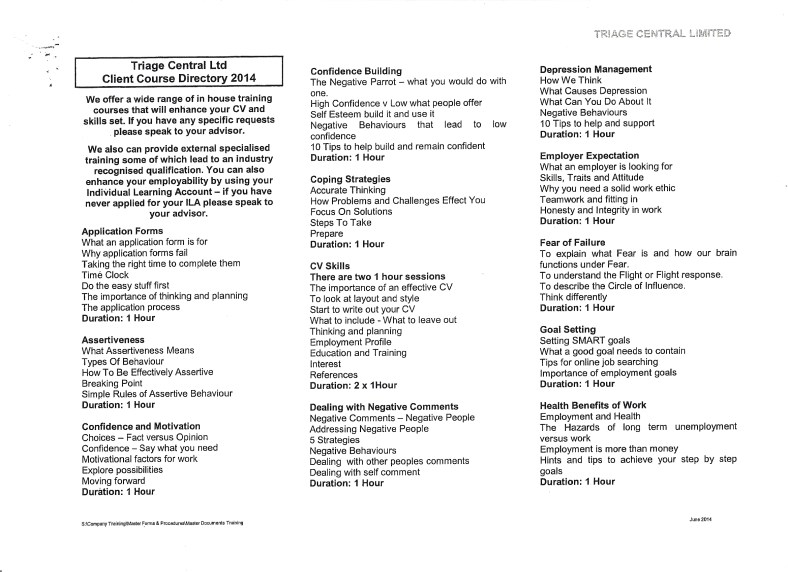
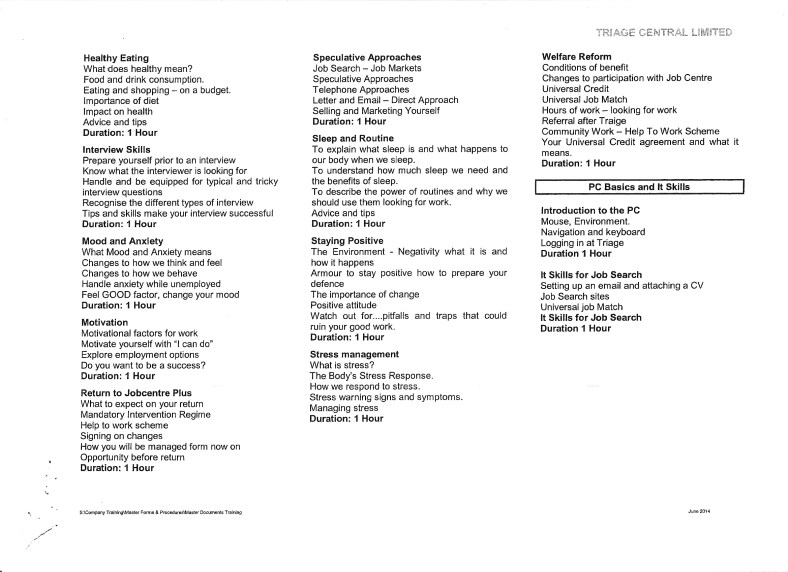
In our neoliberal world, the blame for being unemployed lies firmly with the individual who has ‘failed’ to find a job, and not with a system that fails to create jobs and only succeeds in increasing inequality. The DWP and its subcontractors must therefore be seen to make these ‘failures’ employable, and the unemployed must be conditioned to accept their personal accountability. Much of the responsibility for this conditioning has been handed to the private contractors who run the Work Programme, and they have taken up the task with enthusiasm. Indeed, the list of courses provided by Triage Central Ltd (reproduced below) could almost be mistaken for parody. There is even a section entitled ‘Working Towards a New You’ – which, it seems, can be accomplished in just 1 or 2 days. All those who have found their attendance at Triage to be a major source of fear, stress, anxiety, loss of confidence and depression, will be pleased to discover that in just a few hours all these problems can be addressed by the very same people who helped cause them in the first place. You can also spend an hour learning ‘assertiveness’ – but you’d better be careful not to learn this too well and assert your rights if you don’t want to leave in the company of the police. There is a bit of practical stuff around computers and interview skills, but the rest reads like a particularly annoying self-help book, with titles such as ‘How to spot a tiger and climb a mountain’. I don’t know about tigers, but I can certainly spot the psychobabble behind this mountain of misery.

The DWP also employs around 60 ‘work psychologists’ to assist their ‘hardest-to-help customers’ with the aid of psychometric tests and motivational interviewing. (See ‘My working day’, Moira Coates on her life as a work psychologist for Jobcentre Plus, published in Work and Organizational Psychology Arena.) Of course there is nothing wrong with helping people, who want to work, to look for ways in which problems of health and disability can be accommodated. However, even the most well-meaning psychologist is bound to be compromised when working as part of a system so clearly based on fear and punishment and on ensuring that the lower orders know and keep to their place: a system set up by a government that persistently claims that ‘work is generally beneficial for health’. The health benefits of work are hammered home in the government’s Guidance for GP’s on how to issue the new ‘fit notes’ that, without a hint of irony, have replaced sick notes. George Orwell, eat your heart out.

Triage 1Triage 2Triage 3

Bliadhna Mhath Ùr

2016

Best wishes for 2016 from an SUWN that’s more active than ever, but faces an ever bigger task. Few of us foresaw that 2016 would see us under a Tory government, and the thought of the further destruction that this no-holds-barred band of toffs will try to inflict on our society in the next four years is frightening. They regard the world as their plaything, and look on the poor – and especially the unemployed and the disabled – as lesser beings. At the same time, despite the best efforts of our abject media, more and more people are waking up to what is happening. We have played a small part in this growing awareness, as well as giving practical support and help to a small fraction of this regime’s victims.

This is a start, but it is nowhere near enough. We, as a society, need to draw a line in the sand and refuse to sit back quietly while they pillage and destroy. The attack on welfare cannot be allowed to continue. We cannot sit by while thousands are reduced to destitution and thousands are forced to work unpaid for bare subsistence, and while countless more face abuse and humiliation at the hands of our own government agencies. We need an army of activists, but we – and our comrades in other organisations – are only a small band of (non-violent!) guerrillas.

Even so, the state has not made it easy. We began this last year with the arrest of one of our activists who was helping a vulnerable woman in her encounter with Arbroath Jobcentre, and although, after hearing the ‘evidence’ the prosecution ended up withdrawing the charges, we begin this year with another court case after Tony was arrested again when attempting to accompany another woman to her Work Capability Assessment. (They refused him entry because he had insisted on the basic right to take notes on a previous occasion.) All this attention and police time suggest we must be successfully rattling their cage, and we will continue to do so! Our activists are continuing to accompany folk into jobcentres and assessments, helping ensure that at the very least the DWP keeps within their own rules. (And the two women both got the outcome they were hoping for.)

If these arrests are designed to sap our energy and paint us as untouchables they have not succeeded. The support we have had from folk right across the world has been inspiring, and there were protests at jobcentres across Britain on the day of Tony’s court case. Our only possible response is to develop more activists and use the publicity to draw attention to the iniquities of the system we are fighting. No-one said it was going to be easy – but we’re discovering the true meaning of comradeship. (And if this message isn’t as coherent as could be, blame that SUWN Hogmanay party.)