On this day

This could have been the day of Scotland’s freedom. We could have been cheering the imminent end of some of cruelest policies to come out of Westminster – the end of benefit cuts and sanctions, and the reassurance that we lived in a nation that valued the welfare state and did not want to dismantle it. No doubt too, we would be bemoaning the caution of a Scottish Government trying to please everyone and running away from the bold progressive changes that are needed to make a real difference to fairness and equality, just as they have done with the limited powers that they already have to change local taxation, and will soon have to change income tax.

But, instead of Independence we can look forward to an increase in devolution that is even more limited and uncoordinated than agreed by the Smith Commission: a poisoned chalice that gives Scotland responsibilities without power, especially without the power to change the nature of our economy. Scotland will be gaining control of a few areas of welfare, but even here it is unclear what room we will have to do things differently. Mitigation of benefit sanctions is expressly ruled out.

So what can we do now?

We will continue to provide practical assistance to folk negotiating their way through Austerity Britain, and to campaign against the barrage of attacks coming from a Tory government bent on turning the clock back to the 1930s. We will also push for the Scottish Government to make every improvement it can within the devolution agreement – and when that is shown not to be enough, we will push for defiance of that agreement and of rules that lead only to destitution and misery.

It is no accident that defence of the welfare state has been a constant and central theme in Independence rallies. If a government can’t protect its most vulnerable people, then what use is it? We didn’t campaign for independence so that we could go on as before, just with a parliament in Edinburgh instead of London. We campaigned because we wanted real progressive change, and we will continue to campaign for a fairer Scotland. We know it is no use waiting for our politicians to act. Resistance to Westminster cuts and the drive to implement a better alternative will only be achieved as a response to a movement from below: to the energy and determination that we saw 18 long months ago. We call on everyone to recognise defence of the welfare state as a red-line issue; a cause that has to be won, even if that means civil disobedience. We are forced to look on in impotent horror at the destruction of great cultural monuments of the past such as Palmyra, but all around us the UK government is destroying one of the greatest achievements of the 20th century. We can’t let that happen.

Another Scotland is still posssible

Another quiet day at the Wellgate Buroo

Over the last few weeks we have noticed that things have been very quiet ootside Dundee burroo, and we turned up today with no expectation that things would be any different. How wrong can you be? Even before we had set the stall up, we were called upon to intervene when an unemployed man on ESA was being physically ejected from the premises. As soon as the G4S security guards spotted us one of them disappeared back into the buroo like shite aff a stick, whilst the other security guard, who really quite fancies himself as a hard man, told us to go and reproduce ourselves before also disappearing back from whence he came. When we had calmed the unemployed guy down, which, not surprisingly, took a bit of time, we learned that he had been in the burroo for a meeting to discuss a complaint that he had regarding his treatment at the hands of Triage. He was accompanied by his girlfriend, but was told that she could not accompany him into the meeting. When he objected to this clear breach of his rights all hell broke loose. He claims that he was then set upon by a number of security guards, and that they forced him into the lift where he was yet again assaulted.

When he had clamed down a bit, he phoned the police to make a complaint, but this turned out to be a very convoluted process. A number of other unemployed people who had witnessed the assault and who were willing to provide evidence hung around waiting for the polis to arrive. They waited and waited, and waited some more. Eventually, after around 1 1/2 hours a solitary polisman turned up and then proceeded to very conspicuously ignore the SUWN volunteers around our stall, along with the complainant, before he realised that he had to engage with us. When he did engage, however, he did so in such a manner that the complainant refused to talk to him. The arrogant and high handed manner of this plod was totally out of order and the complainant was quite within his rights to object to the way the polisman spoke to him.

After a discussion among the SUWN volunteers and the complainant we decided that the best course of action was that the complainant should be accompanied by a SUWN advocate to the Bell Street polis shop to make the complaint there. However, when they arrived at Bell Street, the place was not exactly jumping. Indeed, it appeared more like the Marie Celeste than the crime fighting centre of Dundee, and it was around 3/4 of an hour to an hour before two quite young beat bobbies appeared, having been called by the desk sergeant. The resulting interview did not, though, go well and the complainant emerged in an agitated state, due to the line of questioning.

This case remains very live, and shines a very bright light on the way that ordinary people are being treated at Dundee buroo when they dare to object to being treated in a high handed, arrogant and violent manner by the DWP, G4S bullies and their little helpers in Police Scotland. We are sure that this is not the last that you will hear of this case, and we will update as and when we can.

Osborne-world

Yet again we struggle to reconcile the Britain described by George Osborne with the place where we actually live. In a characteristic example of news management, the brutal cuts to disabled benefits had already been announced, but Osborne’s spin machine was working overtime as he smugly referred to this as better targeting support in a rising disability budget. The budget documents claim that the latest changes to how PIP is assessed will save the government £1.3 Billion over the course of the parliament. PIP is the benefit that is meant to cover the extra costs of being disabled, and the ‘savings’ will be made because fewer disabled people will qualify for the benefit, and others who would have qualified for the higher rate will get the lower. And this follows on the heels of the £30 a week cut for people in the ESA Work Related Activity Group (those found not fit to work at present but forced to prepare for work in the near future). Both of these changes will further reduce the amount paid to disabled people. Assuming that Osborne-world must have some sort of twisted relationship to reality I have been trying to look for anything that could conceivably be presented as increased spending on disabled people. The only reference in the budget documents appears to be schemes for getting more disabled people into work. And then it dawned on me. The spending he has been boasting about is the money spent on the whole disciplinary regime. Maximus (the private company that carries out the assessments for ESA) and Atos (who used to do the ESA assessments an now carry out many of the assessments for PIP) don’t come cheap. You have to pay a lot to nurses to make them sell their souls, and then there is the cost of all those ‘work psychologists’, not to mention managers expecting full multinational salaries and perks. This is not money for the disabled, it is money for the disability industry – for controlling the disabled.

Otherwise the budget was the predictable list of tax cuts for the better off: not just income tax cuts for high-earners (dressed up as ‘a budget for working people’), but also help for those who already earn enough to save, and huge cuts in capital gains tax. The inequalities of wealth in this country are even starker than the inequalities of income, and cuts in capital gains tax will only make this worse. Turning income into capital gains is also a standard way of tax avoidance, so Osborne’s hope to recover more taxes seems even more unrealistic than at first glance.

I am sure there will be much more on the budget tomorrow when people will have had the chance to crunch some numbers, but meanwhile here’s another example of disability spin. The other day I accompanied someone to their PIP assessment. The Atos nurse – who was anxious to stress that she did not work for the DWP – introduced the interview by explaining the difference between PIP and the old Disability Living Allowance (DLA) in a way that made the change of benefit appear all in the interests of the disabled. I have no reason to doubt that she believed what she was saying, but perhaps nobody told her that when PIP was planned in 2012 it was expected to save billions of pounds by ensuring that half a million fewer people received disability benefit by 2015/16 than would have been the case if they had kept DLA.

The power of solidarity

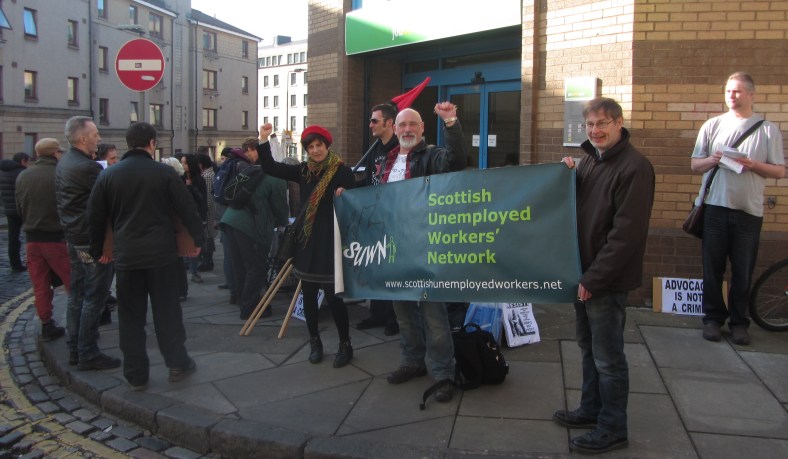
High Riggs Jobcentre in Edinburgh was taught a lesson in solidarity yesterday as a crowd of protesters from across Scotland came to support Bob from Edinburgh Coalition Against Poverty (ECAP) and Chris the unemployed man that Bob has been helping. Chris is one of the people that the Jobcentre has picked on to give a particularly hard time, so ECAP has stepped in to assist. ECAP and High Riggs have a long history, with the jobcentre repeatedly trying to deny people their right to be accompanied, and then having to back down and apologise when shown to be breaking the DWP’s own rules. On previous occasions there have been long stand-offs with the police. Two weeks ago the jobcentre got their own G4S security guards to do the dirty work. ECAP explains: ‘When the claimant and his accompanier attempted to enter, four G4S security guards blocked the way, physically separated the claimant from his accompanier and asserted that the claimant had no right to be accompanied. The four volunteers leafleting came to the door to insist on the claimants rights and were physically assaulted and menaced by the security guards.’

High Riggs 1

Yesterday was Chris’s next visit to the jobcentre. And this time, with so much support outside, Chris (right) and Bob were able to report a rather different reception. In fact, a noticeably relieved Chris told us that he was no longer going to have to see the ‘job coach’ who had attempted to change his agreed Claimant Commitment without consulting him, and that he had been assigned to a different person.

Tony from the SUWN shared with everyone the problems he has had with officious officials in Arbroath and Dundee, which have led to us to become experts on the comparative practices of Forfar and Dundee Sheriff courts; as well as stressing the need for more of the kind of advocacy work we were all there to defend. And Grant led the chanting – which added to the more tuneful noise from Rhythms of Resistance.

IMG_1551

Once again the DWP has provided an opportunity for activists to strengthen the bonds that link our different campaigns – and we were pleased to meet up with old comrades and new from Glasgow, Stirling, Greenock and Angus as well as from Edinburgh. We look forward to seeing many of them again in Dundee on 9 June for Tony’s appearance in court for daring to accompany someone to their Work Capability Assessment.

IMG_1550

As we have said many times before ADVOCACY IS NOT A CRIME. You have a right to be accompanied to your interview, and for the person with you to help you put forward your case. That person does not need to give any ID to the jobcentre (or assessment centre), though the DWP may confirm with you that you want them to be there.

celtic beastie

(Edinburgh was looking awfy bonnie in the sunshine and we also found time to complete our day in our capital city with a visit to the excellent Celtic exhibition at the National Museum – activism, camaraderie and culture!)


From Tayside in Despair

These posts are from an exchange of messages with someone we are trying to help. He has said that we can share them so that others can see the kind of system we are up against:

November 2015: I’ve just seen your post about the blue mile shared to a group I’m on. I too have just been refused either rate of mobility component of PIP because I was able to walk this corridor with a stoop and at a slightly slow pace without showing any pain; so because I have lived in pain for fifteen years and learned to deal with it without vocalising, I’m refused any benefit. I was on highest rate mobility DLA up until May of this year, and wasn’t sent any migration forms. My claim was just allowed to run out, and I left it months to make a claim for PIP because I was so anxious about it. I’m in no fit state mentally to appeal this decision, or ask them to reconsider first, as I’m on the brink of just topping myself. I’ve spent over half my life in agony and have had to deal with the incompetence of the DWP so often that I just can’t face it again; the on-hold song alone drives me insane when forced to listen to it for half an hour at a time so I put off phoning. I’ve had so much unfair treatment at the hands of these unscrupulous bastards that I have no more fight in me and nobody who wants to deal with the DWP on my behalf, therefore I’m now getting low-rate care and no mobility and haven’t the strength to fight them any longer.

I’ve been left for eight months before by them without benefit because they tricked me into work and out of benefit five years ago – sent me to mandatory work-focused interviews, where I was told I was to find a job up to sixteen hours and I’d keep my Income Support. Needless to say, my first payslip was sent to them and promptly a letter was sent back saying I had worked over the maximum amount and therefore wasn’t eligible for it anymore. I appealed three times with no avail. I’m just so sick to death of the system! I’m honestly at the brink of walking into a jobcentre and taking my own life. This system is actually causing me more problems than it’s helping; I now have social anxiety to add to the list of problems I have, but because I’ve not spoke to my GP about it, it’s not there. I don’t know what to do or where to turn.

I know I have a case and could win, it’s just the massive effort it takes me just to get out of bed in the morning never mind any of the appeal process. I’ve had to do it so many times already, I’m just struggling to find any motivation to continue to fight them. The whole system is geared to remove the 0.7% who wrongly claim benefit, and punishes the 99.3% who need and rely on it. It’s so unfair and thoughtless. Why is it then OK for MPs to fall asleep in parliament? I saw a picture the other day of about five MPs all asleep in parliament. It’s disgusting. So fed up of the way things are.

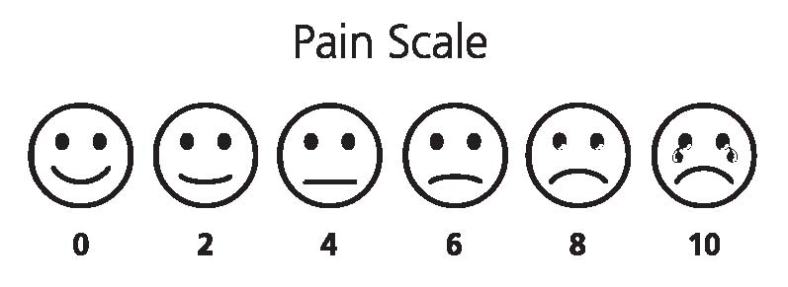
February 2016: I’m still here anyway. I still have no fight in me to try to appeal the decision. Just having to explain it all to someone gets me down because it basically rubs it in my face every time how rubbish my quality of life is. Also I have mandatory biweekly work based activity to do. Even though I’m in the ESA Support group, they’ve got me working on a CV etc. The weeks they don’t call me in I get a phone appointment which is just them asking if my circumstances have changed, basically do I still have my life long, degenerative condition? Obviously ‘yes’ being the answer, but it’s very degrading, for lack of a better word.

Pain-Scale

It’s good to talk!

IMAG1151

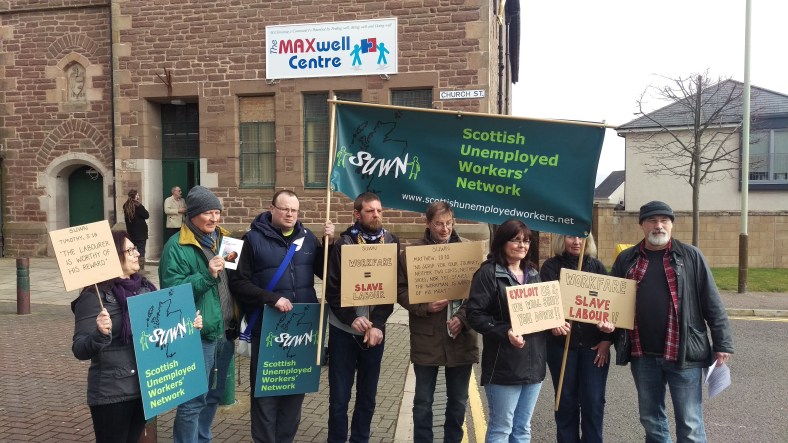
As we had received no answer to our polite letter to the Maxwell Centre about their use of forced labour, we decided to pay them a visit: so, at 11 o’clock this morning about a dozen of us turned up outside their door, complete with placards and leaflets and the photographer from the Courier. The manager seemed rather stunned to see us – but sat down to discuss with us. She said that they had indeed had two people from the Work Programme, but did not seem aware that they would have been press-ganged into coming under threat of having their benefits sanctioned, and not genuine volunteers. We explained that there is no such thing as nice workfare, and even if the Centre didn’t inform the DWP about any failure to participate, people could still be sanctioned. And some time later we were told that the Centre would not be taking any more people from the Work Programme! A few of us are meeting with people from the management board this evening, so we will be trying to formalise this – update to follow. We are optimistic because we know that this is a community centre that is doing lots of genuinely good work, and exploitation of local people isn’t one of their aims. We can also thoroughly recommend their home-made soup – and followers of our blog will know that we are soup connoisseurs.

12834528_869401106501670_1151559095_n

Exploitation in the Community

When we hear of someone being sent to work for nothing at a small community organisation we always hope that there’s been a mistake and that the organisation hasn’t been fully aware of the nature of what they have signed up to. And so we write to them and explain and ask them to think again. But we also make it clear that if they don’t pull back, we will name and shame them for their exploitation. We recently wrote to three organisations here in Dundee, and not one of them even bothered to answer us. All three provide an important community service, but in each case we have spoken to people who have not only been forced to work there without pay or lose their benefits, but have also complained about how they were treated when they got there. The three organisations are Mid-Lin Day Care Centre, the Deaf Hub and the Maxwell Centre.

IMG_1443

While they are not the worst, I was particularly shocked to find the Maxwell Centre involved because I like the place – and I particularly like the community garden. But it was the garden where our contact was being made to work. Mark has been a landscape gardener in the past, so he was a bit surprised when Learndirect, his Work Programme Provider, sent him to work in the community garden for four weeks to build his experience. He was even more surprised when he found that he was given almost no gardening work. In fact he was treated as a general dogsbody, being expected to tidy up, make tea, and hoover the floors in the centre. He was also expected to use his own car to move material about.

IMG_1440

He worked hard for three days hoping that these issues would be resolved, but when it was clear that nothing was going to change, he felt he had no option but to leave. We helped him write to Learndirect to explain why he had ‘good cause’ to do so.

Efficiency DWP style

All those people kept waiting for weeks for their benefits may be surprised to learn that the DWP can be get things done even before time if they want to. We were rung up three weeks back by Kiera from Glasgow who couldn’t understand why she was being called into the jobcentre for an interview. Kiera is a single mum with a baby. She is on ESA and finds it very hard to go out of the house at all. Although the interview letter came out of the blue, it transpired that Kiera had had a Work Capability Assessment recently. When I rang the DWP they told me that they had decided on the basis of this to move her to the Work Related Activity Group, which means that they can call her in for ‘work related activities’; but as they had only just made the decision and notification goes out second class, she hadn’t been told yet. And what about the baby? Once your youngest child is one you can be called in for a work-related interview, and this is clearly what had happened. But not only had Kiera not received her ESA letter yet, her son was not due to be one for another fortnight. Clearly the DWP just couldn’t wait to smother her with their charm. Kiera was less keen. In fact she was seriously worried and I advised her to get a note from her doctor to say that it would be damaging for her to go – and to appeal the ESA decision.

Educating Ingeus

When we are outside the buroo we can try and help with casualties as they emerge from the battlefield, but we also get people contacting us by phone and internet. Dan lives in North Ayrshire and rang us up last autumn after finding us through Google. He was on ESA in the ‘Work Related Activity Group’, and the advisor at Ingeus, his Work Programme Provider, seemed to be having problems in understanding that ‘work related activities’ does not mean work. We seem to have carried out much of the discussion by text (perhaps I was at my work!) so here’s an edited extract:

SUWN: ‘they cannot and should not make you apply for jobs. They can only give you tasks that are designed to make you job ready. I think you should make an appointment with a welfare rights officer. The number for money matters in … is …’

Dan: ‘That’s what that Ingeus advisor kept saying. I’m just getting things in place for when you are ready for work. By applying for jobs? How long does he expect an employer to keep a job open? It was persistent. Every visit is, what about that? And he would show me a job that was on the universal job match website. A few times the job didn’t even exist or was taken. Thank you for the advice.’

SUWN: ‘Tell him that work related activity does not include applying for jobs. And let me know how you get on. I’d like to write a letter of complaint to Ingeus if you would be ok with this.’

Dan: ‘Yes I’m fine with that. Especially after last time I seen him and he told me, we’ll just send out a few cover letters, which as I told you turned out to be 53 of them. Really wish I had took a photo

‘One other thing. When I had appointments with him he told me, you don’t need to wait on me, jump on a computer and do a job search. I just go with the flow. I’m frightened I get sanctioned. Every time I go there I feel really nervous and on edge.’

We agreed I’d write to Ingeus central office, but without naming names or places as Dan was concerned about being victimised for complaining. (Dan was particularly keen for me to do this as he didn’t want other, more vulnerable, people being treated as he was.) We asked them to make sure that all their officers understand that people on ESA have been found not fit for work and that they should not be made to apply for jobs; and we requested an apology that we could pass on to Dan. We received a two page response that sidestepped both these points.

But a week later we got a further text from Dan, who seems to have been emboldened by the whole experience:

‘Just to let you know that I went to the job centre today and explained my situation. The chap I got to see was extremely helpful and understanding. He called Ingeus and I have been given a new advisor. He also told me the same thing you did about not having to do job searches. Very  good outcome. Thank You.’

(Ingeus was founded by the wife of the Australian (Labour) Prime Minister, Kevin Rudd, and their contract with the UK government brings them around £150 million a year (Financial Times, 1 April 2014).)

This is from the DWP’s Work Programme Provider Guidance:

WP provider guidance for WRAG

How to make a low wage economy

Slide1

A friend recently applied for a job as an electrician, but when he was offered the post he was told he would only be paid the minimum wage. He was lucky – he had alternative work – but, as he pointed out, someone on the buroo would not have the choice. For the first three months you should be able to insist on looking for the type of job and level of pay you are used to, but after that you are fair game for the exploiters. In fact, as I told my friend, it gets even worse. Not long ago, we were contacted by a 63-year-old electrician from Glasgow with years of experience who had just been told to take a six-month community work placement where he would be working as an electrician for nothing more than his benefits. Someone on standard rate JSA working thirty hours a week is effectively working for £2.44 an hour. Joint Industry Board wage agreements are being tossed to the wind. Unemployment has always been used to drive down wages, but now our bastardised welfare state, rather than cutting across this, is actively encouraging a race to the bottom.

As we have said many times, mistreatment and exploitation of the unemployed also impacts on people in work. If employers can get free or cheap labour, they will be reluctant to create real jobs with decent rates of pay. Even if they try and pay decent wages they will be put at a competitive disadvantage. And the appalling treatment of people who are unemployed forces workers to accept worsening pay and conditions rather than complain and risk losing their job. If only in the interests of their own members, the trade unions need to be much more active in resisting the government’s attacks on the unemployed.