New tax year, new benefit cuts

(As published in the National)

The daffodils are blooming, so it must be time for more benefit cuts. When you live under ideologically-driven austerity, April is, indeed, the cruellest month.

It is said that you can judge a nation by how it treats its weakest members, and this year, yet again, the sick and disabled find themselves in the UK Government’s cross hairs. Anyone applying for Employment and Support Allowance (ESA) from today who is put in the Work Related Activity Group will get only the same grossly inadequate £73.10 a week that they would get on Jobseeker’s Allowance (JSA). The Government claims that this will encourage them to find jobs – but this is a benefit for people found unfit for work. Even if they were able to find someone prepared to employ them, a job could be seriously damaging.

This comes in the wake of a clamp-down on eligibility for receiving ESA at all. The notorious tick-box assessment system is becoming tighter, and at our stalls outside the jobcentre we are always having to help people (like Daniel Blake in the eponymous film) who’ve been ‘bumped off ESA’ despite being clearly unfit for work. We tell them to request a Mandatory Reconsideration of the decision and apply for JSA while this is looked at. Once they are signed up to JSA they can get a doctor’s note to take off the immediate pressure to look for work – but contrary to the rules laid down in the legislation, jobcentres have been telling them they can’t do this.

Such treatment might seem like pure vindictive cruelty, but it makes perfect sense if understood as part of a deliberate ideologically driven attack on the welfare state. In our increasingly divided society, the greater part of the population are required to fulfil the role of workers and consumers – that is consumers of privately produced goods and services. Work is portrayed as the answer to all problems, and those not working, for whatever reason, are to be despised as failures. While the cuts in benefits have produced immediate savings in government expenditure (they may result in more costs further down the line), this is not their primary purpose. This is a deliberate paring away of the protections that separate us from unrestrained market forces. When unemployment is made both dangerous and demeaning, then workers are forced to accept poor pay and conditions without protest rather than risk their job and a fall into the abyss. And the current system for assessing ESA came out of consultations with a US health insurance firm who were experts in creating a process where people did not qualify for pay-outs, and who envisaged a future where we would be increasingly dependent on private insurance rather than publically funded social security.

Another long-time favourite target is lone parents, and the UK is following the US example by increasing the pressures for them to find work. From this month, they will be expected to do preparatory activities when their youngest child turns two, and look for a part time job when they are three. There is more than a touch of eugenics in official attitudes to poor families, and this is exemplified in the ending of child tax credit (and its equivalent element in Universal Credit) for any third or subsequent children born after 6 April – subject, of course, to the infamous rape clause. They will lose their additional housing benefit too.

All this is in addition to previous devastating cuts, caps, and reduced rates; and the tightening of rules and sanctions, including their extension (through Universal Credit) to some people in work.

But this spring also brings some positive changes in the form of further devolution of benefits as a result of the Smith Commission. These are limited (just 15% of Scotland’s total benefit spend) and are taking a long time to come into bloom. The planned changes to PIP (the benefit to cover the extra costs associated with being disabled) sound good, but many people quite literally can’t wait years for them to be implemented. They need at least some changes now. Even the knowledge that future training schemes for the unemployed will be voluntary and not lead to sanctions will be seem hollow to those who are already on the current two-year schemes and will be expected to see them through.

So, for people on benefits, and people who help them, and anyone who cares about working conditions or the welfare state there is a lot more to campaign about in the year ahead. We need to protest this system at every turn so that it becomes unworkable; we need to ensure that our Scottish government does as much as possible with the powers we already have; and we need to campaign for Independence and the power to create real social security.
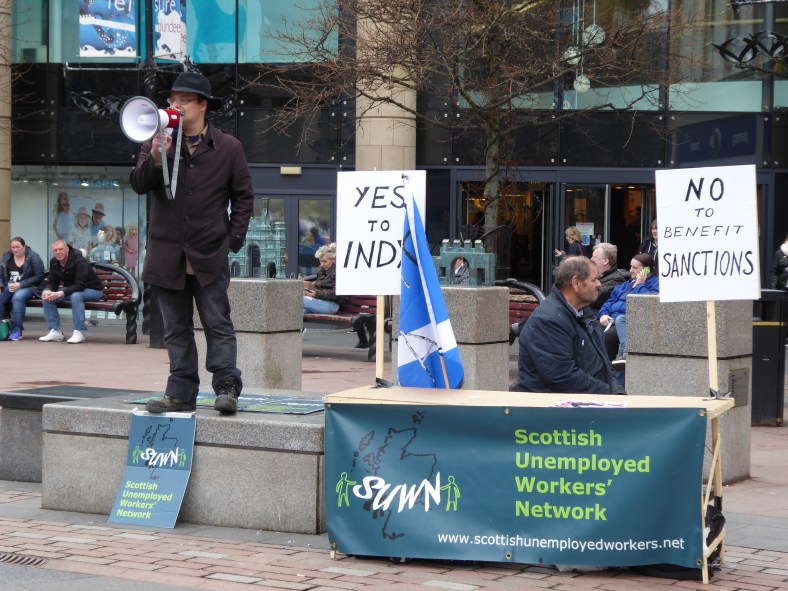
NO to Benefit Sanctions, YES to Independence

P1000123

30 March was called as a National Day of Action Against Sanctions by Unite the Union. As we fight sanctions outside the buroo every week, we thought this was an opportunity to do something different – so, we set up stall in Dundee City Centre to say loud and clear, with the help of the megaphone, ‘No to benefit sanctions, YES to Independence’ and the freedom to get rid of sanctions altogether.

We generated a good amount of interest (including with a big bunch of school kids), and if we didn’t get out as many leaflets as we had planned it was because people wanted to stop and discuss – to discuss Independence, and to discuss their personal experience with sanctions. We were able to give out advice on fighting sanctions too, including to two separate homeless guys.

I have pasted the wording of our leaflet below.

(Thanks to Chris, Duncan, Dave, Norma, Gordon and Jonathan)

P1000121

Today, across the UK, people are protesting against benefit sanctions. The UK Government is turning our welfare state into a system of control and punishment. If people on benefits don’t do everything they are told, then they can have their benefits stopped and be left destitute. Often this happens without them having done anything out of place. And just the fear of sanctions creates constant stress. The stories we hear from the people we help at our stalls outside Dundee Buroo would melt the hardest heart – and raise the gentlest person to indignant anger. Today’s protest says that this system is completely unacceptable.

Sanctions, like most of the benefit system, are reserved to Westminster; and the Tory government shows no signs of letting up on their attack on the welfare state. But we in Scotland have the opportunity to win the freedom to create a better system. With Independence we would no longer have to fight a rear-guard action against a continuous onslaught from the DWP. We could be looking at the end of sanctions and of computer-based disability assessments. We could be looking forward to the future introduction of a Universal Basic Income.

We want to make sure that welfare is at the centre of the Independence debate – to raise people’s expectations, so that when we win we can demand a real difference. We are campaigning for nothing less than a fairer Scotland, which would also provide a source of hope beyond our borders.

9 days, over 14 phone calls, and a lot of Vivaldi later…

skeleton on phone

When I finally got a phone call to tell me that the DWP was lifting John’s sanction we had almost given up on the idea that this was ever going to happen. John is in the ESA Work Related Activity Group – he should really be in the Support Group, but that is another story. He suffers from a whole range of problems including nerve damage in his leg, and some days can’t get out of the house at all.

John has to attend the Work Programme run by Triage in Dundee, but several times he has not been well enough to take part. When that happens he is careful to get a sick-line from his doctor, and he has then been given another appointment for when the sick-line has expired. Sometimes this has resulted in a letter from the DWP asking for ‘good cause’ for the missed appointment, but once that cause has been given, all has been well. When, at the end of October, serious back pain prevented him from going to his Triage session, he dosed himself up on extra high amounts of pain-killer in order to go out and get a doctor’s note (stating he was unfit for Triage or for his volunteer group) and to deliver it to the jobcentre before the session he was going to miss. The jobcentre said all was fine and they would pass the message on to Triage.

All did seem fine, until he received a letter from the DWP dated 6 December saying he was being sanctioned for missing the appointment. He went to the jobcentre to complain, and they said it was nothing to do with them and he must take the letter to Triage. He went to Triage and they said it was nothing to do with them and he should go to the jobcentre. He also rang the DWP, but never received the promised call-back. Triage did, however, acknowledge his ill health by arranging that his next three fortnightly appointments be by telephone, and they gave him a printout with precise appointment times when they would call him. The first two dates he heard nothing from them at all. The third date they rang about an hour early, and they told him that as far as they were concerned his sanction should have stopped. But it hadn’t – and that’s when he rang us. It was now 16 January, and since 6 December he had been surviving on just £25.35 a week. It would have been £29.05 but they were still taking deductions for Council Tax repayments!

When I rang the DWP I was told that they had no record of his doctor’s line, but they did have a note on his file from 13 December – the day after he had rung the DWP – saying that he had to contact Triage before the sanction could be lifted. This totally ignored the fact that, not only had he been in contact with Triage about the sanction, he had never stopped engaging with them.

The first person I spoke to told me that she was referring the case to the ESA maintenance section whose job it was to sort out the ending of the sanction, and that they would get back to me with a decision. When I had heard nothing further by the next afternoon, I rang the DWP again, and was again told they would call me back. They rang the following day and told me that in order for them to lift the sanction they needed a WP09 form from Triage to confirm John had ‘re-engaged’.  John then rang Triage, who told him they had sent this form to the DWP on 14 December. The next morning I passed this information on to the DWP, who promised to ring back within 24 hours. 24 hours came and went, and in the afternoon I rang the DWP again. They said I should be contacting the local jobcentre instead, and gave me another 0345 number. Whenever the automated response asked why I was calling and I said anything about a ‘sanction’ I got a recorded message saying I had to ring the original DWP number and the call automatically stopped. Eventually I got round this by saying the problem was a ‘letter’ and then choosing ‘all other enquiries’. This somehow got me through to Exeter Jobcentre, who were able to put me through to the local jobcentre in Dundee. They looked through John’s file and told me that the last record they had was for 12 December, when they had tried to contact him by phone but got no response. I asked them to check their record of his phone number, and found they had got two digits transposed. However, this didn’t solve the outstanding sanction problem, and they told me to ring the DWP again. This time the DWP said the only thing we could do was ask Triage to send them another copy of the WP09, asking for it to be backdated.  I also took the opportunity to ask the DWP to check what they had down for John’s phone number, and found they only had an old number for a phone he had lost – so it was hardly surprising they had failed to get back to him. This had all taken around an hour. It was now Friday evening, so John had to wait till Monday before ringing Triage again.

On Monday 23, John rang Triage, who said they would resend the WP09, and I delivered a letter to the jobcentre requesting a Mandatory Reconsideration of the initial decision to give a sanction at all. When I rang the DWP the next afternoon they still had no record of the WP09, so John rang Triage again the following day. And finally, that evening, I got the call to say the SANCTION HAD BEEN ENDED, and that he would get backdated payments so that he was only being sanctioned for a week. He has since told us that the Mandatory Reconsideration was accepted too, so even that week’s benefit has been reimbursed.

In case this treatment was not enough, I was shocked to discover that John had been living without mains electricity for six years. The problem began when his supplier accused him of tampering with the meter: he had been using very little electricity because he was often away from home. He was never taken to court, so he never had an opportunity to put his case and clear his name. But he was told that to retain his connection he would have to pay £2000. He said he would do without, and that is what he was doing, relying on an elaborate system of batteries. He had sought help in the past, but nothing had been resolved. We put him in touch with the council’s Dundee Energy Efficiency Advice Project – and he now has mains electricity again.

‘You’re better off in jail’

IMG_3888

Those were the words of one of the many unhappy people we met outside Dundee buroo this week. He had been sanctioned, and his observation was based on personal experience.

There were other sanction cases too. James had been sanctioned for 65 days for not coming to an appointment that clashed with his college course. He had informed the DWP, of course, but the relevant information had got lost. He wasn’t surprised at this because they had been consistently chaotic, even sending him appointments at a Manchester jobcentre, rather than Dundee. And now he was waiting for an overdue hardship payment. We asked him to contact us if the payment didn’t come through that day and he needed immediate support.

Alan had missed a Triage (Work Programme) appointment back in October because he was at a job interview. He had told them and they had also phoned on the day to say ‘where are you? They then demanded to see a letter from the prospective employer, but the arrangement had been word of mouth. We explained how a Universal Credit sanction will only be lifted once you have shown that you have done whatever was asked of you, and again ensured he had our details in case more help was needed.

Robert was rather less bothered about his sanction because he was starting a job in 2 weeks’ time – but we did have to warn him that if the job didn’t last long, the sanction would still be hanging over him, so it was worth appealing. Also, the DWP shouldn’t be allowed to get away with treating people in this way.

As usual, there were ESA problems too. Paul had been told that it didn’t matter that he was in pain. He had explained that he couldn’t sit and had problems getting around – and they had said he should use a wheelchair…  We gave him details of people who could help with an appeal.

Richard’s life began to unravel when his mother died ten years ago, and he is now in a homeless hostel. He had a break in his ESA claim due to a spell in prison and is only getting the basic £73.10 assessment phase rate – minus deductions for outstanding debts – until the DWP ‘decision makers’ look at his case and agree to reinstate his benefit. We gave him details of that week’s welfare rights drop-in sessions as they should be able to escalate this process, and we also helped him make a claim for PIP, which should provide him with further support and backup.

Kirstie had come up against the inflexibility of DWP bureaucracy, which doesn’t allow for people’s actual circumstances. Her ESA claim had been shut down because she was unable to provide the identification evidence demanded of her. It seems the DWP hasn’t worked out what to do when someone has no passport or driving license and lives with another family member and so doesn’t have their name on the utility bills – yet that can’t be a very rare occurrence.

There were also several new signers-on who were glad of our rights leaflet and the chance of an informed chat: two made redundant from the rigs and two from the Flint Group printing company, which has just closed its Dundee factory, with the loss of 110 jobs.

And finally, a bit of good news – or at least not-so-bad-in-the-circumstances news. Helen, who we have helped in the past, told us with huge relief that she would no longer have to face the jobcentre as she had just got herself a 20 hour a week retail job. She wants full-time work, but in these days of lowered expectations, she was just pleased that it wasn’t a zero-hour contract.

(The photo is from the previous week – we were too busy to get the camera out this time.)

Independence can’t come too soon -Westminster ‘austerity’ is killing people

yes logo

As last time, the SUWN will be campaigning hard for our right to run our own country AND for the policies that will bring in a fairer system when we have won that right. The change of flag needs to symbolise a complete change of outlook. This is an opportunity to redefine what makes a good society, and we will aim to ensure that social security is central to the Independence debate. An independent Scotland would open a wealth of possibilities. Instead of fighting a rear-guard action against a continuous onslaught from the DWP, we could be looking at the end of sanctions and computer-based assessments, and the future introduction of a Universal Basic Income. But we can’t take any of this for granted. If we want to see real change, we need to demonstrate what is possible now. We need to raise people’s hopes and expectations, so that when we win Independence we can’t be told to go back in the box and be satisfied with minor reforms. We must demand a real difference in Scotland that can also provide a source of hope beyond our borders.

The SNP has chosen to use Brexit as the trigger for a second referendum. We have argued that there was already ample cause  for another vote in the UK Government’s failure to implement the ‘Vow’, and that the Scottish Government’s inability to protect our most vulnerable citizens from the depredations of UK ‘austerity’ should have been a red line issue. But whatever your view on the EU – and we have activists who voted on either side of that referendum for a variety of reasons – we now have an opportunity to make real change here in Scotland.

In 2014, YES won massively in the schemes, but we were beaten by the higher turnout among more prosperous voters who feared that change might impact their comfortable existence. This time we need to ensure that the working-class vote is big enough to win us the freedom to create a better system.

Another busy day at Dundee buroo

Th National 2More ESA problems and benefit delays kept us busy outside the jobcentre yesterday – and if everyone we spoke with followed our advice, the welfare rights drop-in in the afternoon will have been busy too.
Worryingly we learnt of another example of the jobcentre claiming that someone couldn’t submit a sick note from their doctor when they were on JSA while putting in a Mandatory Reconsideration for an ESA Work Capability Assessment. This is not what the law says –as we have written about before. Anyone in that situation has to be treated the same as anyone else on JSA. In this instance we didn’t have to take it further though, as the man concerned was told by the jobcentre that his mandatory Reconsideration had just been rejected, so he can now go on to put in a full appeal and be eligible for basic rate ESA again while that goes through.

All this focus on making it hard for people applying for ESA has probably taken some of the pressure off people on JSA, and we should admit that many emerge from the jobcentre without problems; however years of cuts and crackdowns have undoubtedly resulted in pretty low expectations. The meanness of our benefit system was emphasised by a German woman who was shocked to find she was expected to live on only £73.10 a week. She told us that in Germany if you lose your job after a year you get 60% of your salary. Of course some of the systems that reward long-term employed in that way can be very harsh on those with more precarious work histories, but UK benefits are brutally low by any standards. The least talked about cut, but one of the biggest, has been the freeze on benefit levels. This was implemented last April and followed three years with a rise of just 1% and three decades when benefit increases lagged behind wage rises.

The inbuilt callousness of the system is demonstrated by the increasing number and length of benefit delays. The prevalence of precarious and low-paid jobs makes every delay a potential disaster, and yesterday we had to arrange two food parcels for people waiting for their benefits – one for a young homeless couple and one for a man who had lost his job after being injured in a road accident.

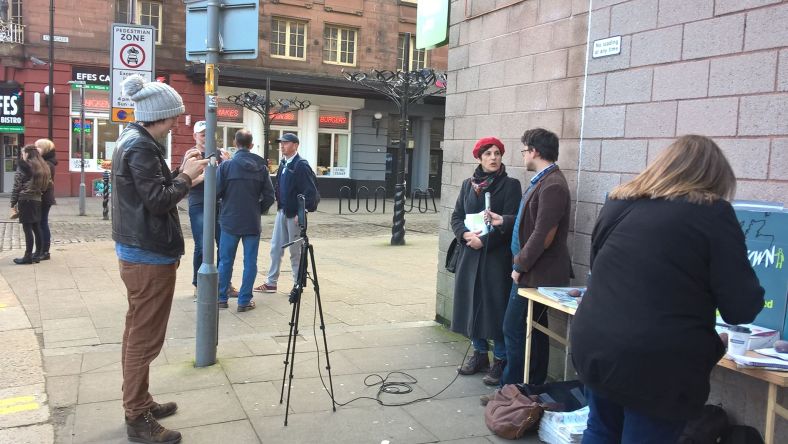
Our stall was visited by the National Road Show, which spent the day in Dundee (see photo by Norma Drummond). They made a wee live video, but we don’t seem to have made it to the paper edition, where the upbeat vision of our city will seem unrecognisable to many of the people we meet with.

PS Hammond’s uninspiring budget showed no deviation from austerity and an extraordinary blindness to the Brexit elephant in the room. It was, received by the usual baying of MPs, especially at every jibe he made at Jeremy Corbyn. The phrase ‘ordinary working families’ appeared four times (a fifth if you also include ‘ordinary working people’) but he had nothing positive to offer most workers, let alone people without jobs who’s future of decreasing benefits and increasing policing has already been mapped out. And with reference to that last point, in February the government announced that the ‘DWP will work with an external data provider to better identify fraud and error caused by undeclared partners’. After the disaster resulting from using a private company to chase supposed overpayments of tax credits, are we to see a repeat with benefits?

Thanks to Tony, Norma, Gordon, Susan Dave and Gary

Making life harder one step at a time


jobcentre pins

As the full Universal Credit ‘service’ gets rolled out to more areas, growing numbers of people are finding a new hurdle in the way of them getting the help and advice they need. In these areas (listed below) anyone who is helping a claimant and needs to contact the DWP on their behalf can no longer just provide their basic data, they will need the person being helped to give their consent themselves – either verbally over the telephone or through their online journal (we’d all just be numbers on a computer if the DWP had their way) or in person at the jobcentre. Getting through to the DWP by phone is rarely quick and easy (cue lots of tiny Vivaldi), and what if someone has learning difficulties or is in hospital…? Furthermore, this consent only covers the particular question being asked. If you need another separate piece of information you will need to start the process all over again. These restrictions apply to everyone who is trying to help, including MPs. Frank Field, who is Chairman of the Work and Pensions Select Committee, and hardly a friend of the benefit system, has described that as ‘a major barrier to justice’.

So far, the areas affected in Scotland are: Greenock, Inverness, Kirkintilloch, Musselburgh and Port Glasgow. (For the full UK list click here and look for the asterisks.)

More sanctions, and that difficult second ESA application

no-to-benefit-sanctions-cropped

Perhaps we were getting too complacent about the decline in sanctions. At last week’s much-too-busy stall we encountered three people who had been sanctioned – including one who had contacted their Work Programme Provider, Triage, to tell them that they couldn’t come to an appointment because they were going to be at college; and another who was on Universal Credit and doing part time work and whose job had clashed with his Jobcentre interview. As always, we advised them to appeal, and that it was worth doing this even after the statutory month if the DWP had clearly broken their own rules.

When the Scottish Government takes over the training schemes that replace the Work Programme these will be voluntary, but jobcentre sanctions will still continue, and David Webster’s most recent report gives considerable cause for concern. Also, the Scottish Government has just let us know – in response to an enquiry we sent them – that although no new people will be sent to the Work Programme from April, the existing contracts stipulate that people already on the scheme will have to serve their full two years.

David Webster’s latest analysis of the DWP’s sanctions statistics also draws on the reports published by the National Audit Office in November and the Public Accounts Committee last month. He informs as that, although the sanction rate for people on JSA is the lowest it has been since February 2010, around a third of unemployed people in the UK are now on Universal Credit rather than JSA, and the sanction rate here appears to be much greater. The DWP haven’t got round to producing statistics yet, but the National Audit Office reports that you are almost twice (1.8 times) as likely to be referred for a sanction if you are on Universal Credit than if you are on JSA. With more people moving to Universal Credit all the time, as well as its much harsher hardship rules, this is very worrying. There has also been a small increase in the proportion of sanctions for people on ESA and pushed into mandatory work related activities, and a Government Green Paper produced in October put forward the idea of extending the sanctions regime to the ESA Support Group.

The statistics suggest that far from being used as a last resort for the more recalcitrant cases, as the DWP claims, JSA sanctions are just as likely to be given to someone only recently out of work as to someone who has been unemployed for a long time.  People who are long-time unemployed tend to have been sanctioned more often, but only in line with their longer time on JSA.

The National Audit Office report confirms that the rise and fall in JSA sanctions reflects changes in management pressure on Jobcentre staff to refer people for sanctions. It also reveals that since 2013 some sanctions decisions have been made by jobcentre staff and not a remote and unapproachable ‘decision maker’ – and that the official guidance note insist that claimants are not made aware of this.

*      *      *

The other major issue that we keep coming across is people having problems with ESA. Last week’s stall was no exception, and a couple of folk had an additional problem. Because they had applied and been refused ESA in the past, they had not been awarded the usual ‘Assessment Phase’ ESA of £73.10 a week while they waited for their Work Capability Assessment. We have checked with the Child Poverty Action Group, and what you need to do in these circumstances is apply for JSA, just as you would while you wait for a Mandatory Reconsideration to be looked at. The DWP have effectively said that you are fit for work, so although you have put in an ESA claim and are waiting for a Work Capability Assessment, you can apply for an out-of-work benefit and this is the only way you will get any money. Once your JSA claim has been accepted you can then get a doctor’s note for an extended period of sickness, like anyone else on JSA. Also, as in other cases when you are in difficult circumstances, you can always try contacting the Assessors and making the argument for an early assessment. (We should just add that a second ESA claim will only be considered at all if it is for a different condition to the one that was refused or your condition has got significantly worse.)

Luckily, our stall coincided with a Welfare Rights drop-in session in the shopping centre nearby, so we were able to send them a steady stream of people with problems. Other issues included a man who had recently come out of prison to find that not only was he homeless but his DLA and ESA had both been stopped leaving him with no money. He had been refused a Scottish Welfare Fund emergency grant on the grounds that he was staying in a hostel that provided a daily meal, but he told us that for other things he was shoplifting.

We were also able to let someone know that the jobcentre was being incorrect in signing him onto Universal Credit when he should still be eligible for contribution based JSA; to inform someone else that if her sister had indeed been refused Universal Credit because she was pregnant this was not right and she should get help; and to commiserate with someone who had been sent over from Arbroath in search of a job that turned out to have been completely misrepresented by the Arbroath Jobcentre. We also went in with the man we had helped the previous week to ensure that his sick note was indeed accepted OK.

Among the people going in and out of the buroo were some soldiers carrying out a bit of economic conscription among the unemployed. We were told they’ve been in there quite a bit lately.

Thanks to Gordon, Tony and Ailsa.


The Government scorns data because sanctions were never about getting individuals into jobs

17-02-21-sanctions-report

The House of Commons Public Accounts Committee report on Benefit Sanctions has just been released. This is highly critical of the way the system is run, and does point out that sanctions can have serious negative consequences – for people’s ability to find work as well as their wider well-being. But it never really questions underlying principles, or stops to ask what this is all for. Any changes that it manages to squeeze out of the government will only be nibbling at the edges, though they may make a difference to some people directly affected.

A system that is conditional on people looking for work will always include some form of sanctions to ensure that people comply. The current concern is that both the conditions put on people and the sanctions applied have grown exponentially in recent years – especially under the Tories but under New Labour too. By making conditions for people on benefits increasingly onerous, the government ensures that British workers accept poor pay and conditions without public protest for fear of something worse; and by deliberately stigmatising the unemployed, government aims to cut across people in and out of work making common cause in resistance.

The report criticises the DWP for being inconsistent and for failing to collect data and monitor the effects of their actions. But, it’s not so much they don’t know what they’re doing, they don’t really care to know, because sanctions were never about getting individuals into jobs. This is a system of control, and as such it is working just as intended. And for control based on fear, inconsistency and unpredictability is a bonus. In fact, they don’t even have to sanction people as often as before, because that fear has been absorbed by both benefit claimants and those in precarious work and is expressed as self-regulation.

In the SUWN we argue against all sanctions – not just for a return to a less punitive past. This is not a dream. It can be achieved through the adoption of a system of Universal Basic Income for everyone. That would bring an end to means testing too.

Here are the key conclusions and recommendations from the House of Commons report:

  1. Benefit sanctions affect a large number of people, sometimes leading to hardship and undermining efforts to find work. Around a quarter of people on Jobseeker’s Allowance between 2010 and 2015 had at least one sanction imposed on them. Suspending people’s benefit payments can lead to rent arrears and homelessness. While these consequences can encourage some people to look for employment, they can undermine others’ efforts to find work. The consequences of sanctions on claimants can be serious so they should be used carefully. However, sanctions can be imposed for honest mistakes. Citizens Advice highlighted the need for flexibility for people who are trying their best. Recommendation: The Department for Work and Pensions should undertake a trial of warnings (rather than sanctions) for first sanctionable offences, as recommended by the independent Oakley Review and the Work and Pensions Select Committee.
  2. Sanctions are imposed inconsistently on claimants by different jobcentres and providers. Sanction use varies substantially, some Work Programme providers refer twice as many people for sanctions as other providers in the same area. The Department for Work and Pensions (the Department) told us there will always be variation. This does not mean that current levels of unexplained variation are acceptable. It is important that the use of sanctions is fair and consistent and the Department has not analysed why some jobcentres use sanctions so much more than others. Jobcentres may be applying different standards. Citizens Advice and Crisis are concerned that inconsistency affects vulnerable claimants the most. Some vulnerable claimants can be excused from having to meet benefit conditions, but the Department does not monitor how often these exemptions are used, so it cannot be sure that vulnerable people receive the protection they are entitled to. Recommendation: The Department should monitor variation in sanction referrals and assess reasons for the differences across jobcentres. It should monitor the use and take-up of protections for vulnerable groups, reporting back to us by the end of 2017.
  3. The Department’s data systems are not yet good enough for it to routinely understand what effect sanctions have on claimants’ employment prospects. There are significant gaps in the Department’s understanding of sanctions and it has not prioritised the improvement of its data. It may be difficult or impossible to determine an ideal level of sanctions, but the lack of data in this area is a barrier to making improvements. The Department now plans, over the next 12 months, to improve its old and poorly-connected systems, to extract better data, and allow it to track the impact sanctions have on claimants’ earnings. Recommendation: The Department should report back to us by the end of 2017 on its progress in improving data systems, including on linking earnings outcomes to sanctions data, and addressing recommendations for better information made by the UK Statistics Authority and National Audit Office.
  4. The Department does not understand the wider effects of sanctions. The Department intends that sanctions prompt claimants to comply with conditions and take up support from jobcentres. This should make people more likely to find work. The Department emphasised evidence that sanctions increase employment, but the evidence is also very mixed. Sanctions can lead to short-term and lowerpaid work. Other people stop claiming after a sanction without finding a job. This can create knock-on effects that others pay for, such as using food banks or needing advice from local authorities or charities for dealing with debt. Recommendation: The Department should work with the rest of government to estimate the impacts of sanctions on claimants and their wider costs to government and report back to us on progress at the end of 2017.
  5. The impacts of sanctions can be worse for people with housing-related barriers to employment. For some people, their main barrier to moving into employment is the struggle to find, or keep, a permanent roof over their head. The charity Crisis raised concerns about sanctions exacerbating these housing-related barriers to employment, and even causing homelessness in some cases. A third of people surveyed by Crisis who were claiming Housing Benefit had this stopped because of a sanction. The Department confirmed that Housing Benefit should not be stopped due to sanctions and told us that it found no evidence of the problem when it examined the issue in one area. Recommendation: The Department should work to better understand the relationship between sanctions and the housing-related barriers to employment that some people face. It should set out what more it will do to assure itself that Housing Benefit is not being stopped in error due to sanctions.

A week in the life of welfare activists


18-02-18-anti-cuts-demo-sinaed-daly

In between showings of I, Daniel Blake we have been helping real Daniel Blakes navigate a system that is always evolving new ways of punishing them. We tell everyone that if they are bumped off ESA (the benefit for those unable to work) at their Work Capability Assessment they can put in for a Mandatory Reconsideration, sign up for Jobseeker’s Allowance (JSA), as they have been found ‘fit for work’ and this is the only way they can claim benefits, and then – like others on JSA who become ill – get a doctor’s note for an ‘Extended Period of Sickness’. Indeed we have argued that if Daniel Blake had known to do this it might have been a very different film. But at our stall outside Dundee Jobcentre on Tuesday we came across a very frustrated and worried man who had gone through this process and just spent over an hour failing to persuade the jobcentre to accept his ‘fit note’ – the DWP’s new name for a sick note. This looked alarming, both for him and for others in similar circumstances. One of our activists went with him when he had to sign on on Friday, and they brought a copy of the rules on the Extended Period of Sickness, as set out in the official JSA Regulations (1996 with later amendments). This time he was told it was just a case of his not yet being fully registered on JSA, and there would be no problem once this had happened. We will go with him to his next meeting to check this is indeed the case.

Our stall was also there at the right time to provide emergency help to John and Karen, who had no money for either food or fuel. She had also recently signed onto JSA after having been refused ESA, and had been expecting a payment; but the DWP had decided that she and her fiancé should apply for benefits as a couple, and rather than help them transfer over, they had just closed their existing claims, leaving them with nothing. We arranged a food delivery from Taught by Muhammad and sent them off to the council to contact the Scottish Welfare fund for an emergency grant.

John and Karen were content to be treated as a couple, but Nick and Gemma were not. The trouble was that someone had contacted the DWP asserting that they were living together while claiming benefits separately. The rules on cohabitation are absurd. Many modern relationships don’t fall neatly into one category or another, and no-one should have to make decisions on whether to move in together based on benefit rules; but in this instance – and we’ve come across similar examples before – the underlying problem was homelessness. Nick lost his tenancy in September, and since then has been sofa surfing between his two sisters, his father, and Gemma. They asked us to accompany them to their ‘Compliance Interview’ at the jobcentre, where they had to give statements to a DWP officer. Nick explained that Gemma is a long-term friend and that he had been persuaded to use her address by his ‘Jobcoach’, who had told him that without a contact address he would have to come to the jobcentre every day to sign on. Gemma was there and so it was easy to ask to use her address as a ‘care of’. No-one had warned him of the possible implications. Their statements and completed form will now be sent to a ‘decision maker’ who will decide if he or she chooses to believe them – or not. (We were able to give Gemma advice about applying for PIP too.)

We accompanied one woman to a PIP assessment and another, Betty, to a Work Capability Assessment for ESA. Betty had major mobility problems (among other things), so I suggested that she ring Maximus first to arrange for someone to punch a code in the car-park barrier so I could drive her right up to the door; but they told her firmly that this was not possible. As it turned out, I found someone else working in the building to let my car in, and the Maximus doctor arranged for the barrier to be raised so I could bring my car up to the door again afterwards – but I wonder how many people are forced to go through extra un-necessary pain by that barrier. It was bad enough watching Betty struggling slowly, with frequent stops, down the internal corridors.  Betty had first asked us to accompany her back in the summer, but that time, after we had struggled to the centre through monsoon rain, she had been told to go away again as the assessor hadn’t been able to come in that day. It had taken them six months and another cancelled appointment before they finally saw her. A letter of complaint is being sent to Maximus about the barrier.

We were also able to help with a couple of further cases over the phone.

But we are not just a welfare organisation, albeit an organisation giving the sort of help that office based organisations can’t give. We don’t want just to provide sticking plaster for the wounded, we also try and publicise what is happening and campaign to change the system. Alongside this welfare work, I spoke for the SUWN at post I, Daniel Blake panel discussions in East Kilbride and Blantyre, and we leafleted other showings of the film at community centres round Dundee. We want to make sure people have up to date information on the rights we still have, and we also hope we can help direct some of the anger generated by the film into useful organised resistance. All the post-film discussions I have taken part in have been different; the Blantyre one was noticeable for focussing on the link between unemployment and insecure and zero-hour jobs.

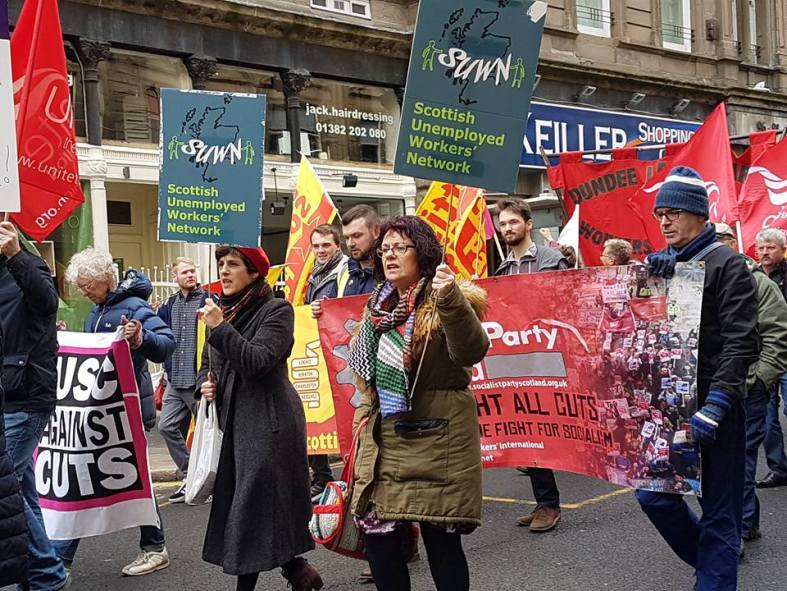
And finally, we took the SUWN placards and leaflets on the demo against cuts in Dundee’s Albert Square. While we will never forget that the source of these cuts is the Tories’ brutal attack on public services and the welfare state, and while we welcome those actions that have been taken by the Scottish Government to mitigate their impact (including mitigating the Bedroom Tax and providing the Scottish Welfare Fund), we know that a lot more could be done to make the best of the powers that we already have in Scotland, and to actively resist the implementation of Westminster’s attacks on the most vulnerable. We all, including our politicians, have to decide which side we are on.

We are still not many and there is so much to do – if you want to join us, or discuss plans for similar activities in your community, please contact us! admin@scottishunemployedworkers.net or 07803 052239

(Photo by Sinaed Daly)