Trial by torture at Dundee ESA assessment centre

interogation cell

Linda works as a cleaner for Angela, who is 58 years old, and suffers from a badly damaged back, comprising three fractured vertebrae and five bulging disks. In addition, Angela has also been diagnosed with Crohn’s disease, a hiatus hernia and depression (these are only her main conditions – she has many more). Back in April, Angela received an ESA form, and she eventually attended a Work Capability Assessment at the Greenmarket Assessment Centre last week. She had been provided with a phone number in order to ensure that taxi travel would be paid for, and, in the course of the phone call to Greenmarket, Linda, who had agreed to help, also asked how far Angela would be expected to walk to reach the assessment rooms – she was informed it was no further than ‘fifteen steps’. Linda was also informed that a taxi could not be arranged for her and that she would need the code to operate the barrier to the assessment centre car park. Things seemed a little more complicated than they should be and Linda agreed to accompany Angela to the assessment centre.

They took a taxi, which managed to sneak under the barrier as a car in front of them entered the car park. When they disembarked from the taxi, however, they found, to their horror, that the ‘fifteen steps’ they had expected to negotiate turned out to be more in the region of 25-30m from the entrance to the reception area. This was a real problem for Angela, as based on the info they had received, she had came with crutches rather than the wheeled buggy she also has, which provides more support. Linda then asked staff for a wheelchair so that Angela could negotiate the corridor, but was informed, to her horror, that no wheelchairs were kept on the premises. Having struggled into the reception area, and nearly fallen over, Angela and Linda were, mercifully, only kept waiting for ten minutes before she was called into the assessment, but they were again horrified that Angela was expected to walk a frightening distance (for her) to get to the assessment room, which she only managed with extreme effort and no little pain.

The assessment itself, they had been told, could last as little as twenty minutes, but it took more than an hour of questions before the male assessor was ready to conduct a physical examination. Angela was asked to stand up and to hold her arms out in front of her. The effort involved was too much for Angela and she fell over, and was left by the male assessor to pick herself up. The assessor then left the room in order to let Angela ‘compose herself’. By this time, Angela was in a highly distressed state, in tears and in a lot of pain. When the assessor came back to the office, after consulting a doctor, he, unbelievably continued with the physical examination, but allowed Angela to be seated, which, I am sure readers will agree, was very compassionate of him.

The assessment came to an end shortly afterwards, but the torture did not end there; Angela still had to walk back the length of the corridor. She was absolutely shattered, emotionally and physically, by her experience at the hands of Maximus. Linda admitted that the experience had also ‘shaken’ her, and she said this as someone who does not see themselves as a person who is easily upset. The treatment that Angela received is appalling, but all too common. We can assure Maximus that they have not heard the last of this inhuman outrage, and we have advised Linda on the best course of seeking redress. As for Maximus, hell mend them.


Sharing knowledge in the face of further attacks


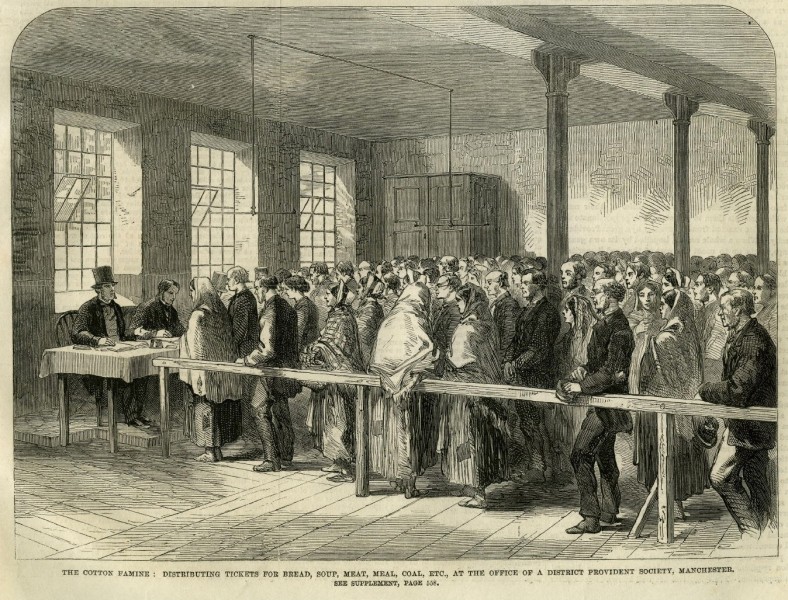
Unemployed in Manchester 1862 collecting tickets for bread etc

Unemployed cotton workers in Manchester at the time of the American Civil War

Three overwhelming impressions from last weekend’s Boycott Workfare gathering in Manchester:

  • what a lot of knowledge and experience was combined in that room
  • the size of the task we have taken on as the ‘Welfare Reform’ monster continuously morphs into new shapes
  • however dreadful things are in Scotland it is even worse south of the border (without the Scottish Welfare Fund, mitigation of the bedroom tax, funding for welfare rights, a wide political awareness of the horrors of welfare ‘reform’, and the expectation that MPs will be broadly sympathetic).

Five SUWN activists made the long bus journey down to Manchester for an important boost of UK-wide solidarity and a whole lot of useful information. We want to share some of the things we learned.

The first session was run by Rick from DPAC and was full of helpful discussion on applying for ESA and PIP. Here are some key points:

When you start a claim only give the minimum information on the phone. Keep details of your condition for when you have the form and time to think.

The questions on the application forms are not designed to enable you to make a good case. You need to work back from the descriptors of what gets you points and make maximum use of the description spaces on the form, adding as many extra sheets of paper as necessary. You can also expressly point out at the assessment how you qualify for those points. You can check them off during the assessment and remind the assessor at the end. And you can prepare beforehand how to answer the question of how you spend a typical day. (Remember that PIP will only be given for conditions that affect you for more than half the time, but being able to do something means being able to do it reliably and repeatedly, and preparing food means a proper nutritious meal.) (You can find the descriptors here: http://www.benefitsandwork.co.uk/personal-independence-payment-pip/pip-points-system and here: https://www.benefitsandwork.co.uk/employment-and-support-allowance/start-the-esa-test.)

Assume you will have to appeal the decision so you are not disappointed, and don’t let your almost inevitable failure at the Mandatory Reconsideration stage stop you from going on to the full appeal.

Views differ over getting them to record the assessment. This will provide an accurate record, but will include things that you could have said better.

Greenwich Unemployed Workers Centre have produced a ‘safeguarding form’ which you can use to make the different authorities take extra note of any vulnerabilities, but people may be wary of giving permission to share their data, and mothers need to be extra careful not to do anything that might be interpreted as showing them unfit to care for their children.

In the session we coordinated we discussed the wide range of activities that can be combined so that practical grassroots help and wider campaigning boost each other – also the possibilities of getting more working people involved in campaigning as Universal Credit puts them under the same pressures as the unemployed. We learnt that In Ashton Under Lyne, where Universal Credit is already being applied to everyone, low paid jobcentre staff are sent to Oldham for jobcentre interviews so they don’t have to be sanctioned by their immediate colleagues; and we heard that Keep Volunteering Voluntary has signed up 660 charities who will not use workfare. Similarities were drawn between treatment of the unemployed and of prisoners forced to provide free labour – including the same private companies involved. And we discussed the difficulties of carrying out direct action while not preventing people accessing vital benefits.

The final section (with Refuted.org and Debbie from Ashton Under Lyne) looked at some recent and upcoming DWP attacks. Here’s some of what we’re going to be up against:

From April 2017 there will be extra pressures on 18-21 year olds from the day they sign on, with compulsory training or work placements after six months.

Supported housing for young people can be made dependent on compliance with jobsearch requirements – this is currently being trialed in Salford.

DWP staff are being sent into schools to advise pupils on their future careers – but their only training is a 6 week NVQ in jobcentre admin and management and people have been given really bad and factually incorrect advice.

Workfare is embedded in Universal Credit legislation, and people in work but deemed not to be earning enough could be forced to do unpaid work as well to qualify for their Universal Credit.

Further integration of unemployment and health services and their budgets is already being piloted in various parts of England and Wales. (This is based around the idea that work is a health outcome.)

It is expected that people will have to make fewer visits to the jobcentre as more is done on line. This may make it harder for us to reach people.

Universal Credit can require people to wait up to 12 weeks for their first payment – and eviction processes in England can start after just 8 weeks.

Some under 25s on Universal Credit have been made to sign a Claimant Commitment to look for work for 48 hours a week, not 35, to compensate for their lower minimum wage.

A lot of Universal Credit rules have been brought in through statutory instrument, so avoiding any parliamentary scrutiny.

In England all this is being implemented using a computer programme called Verify that gathers together all personal data.

But we also discussed some possible areas that can be campaigned on:

The business case for Universal Credit is not yet signed off. Anything we can do to make it more difficult to administer (such as appealing every sanction) could help kill it off – and small businesses might be persuaded to campaign against it on the grounds that it will give them extra costs.

Now that the DWP can go on putting pressure on you even when you are employed it can be important that employers respect your confidentiality so that the DWP can’t use them to spy on you or to change your work hours against your interests. You can make it clear to your employer in writing that you do not give permission for them to pass on information about you, though you will still need the DWP to have some information about your work hours etc as Universal Credit is calculated on what you have earned each month.

Discussion on how to get more young people involved inevitably brought up the 1985 School Student’s strike, which stopped the mandatory enforcement of YTS – Thatcher’s Workfare. So it was particularly apt that a couple of days later we received this link to BBC footage of the protests, featuring our own Tony Cox. http://www.bbc.co.uk/programmes/p040qbk8 As you can see, the ‘threatening’ raised finger, which has caused so much consternation in DWP offices, is a long ingrained habit.

There was general recognition of the need to keep in touch with each other and keep sharing information and tactics. None of us underestimates the scale of what we have taken on – or its potential significance in the bigger political changes we are caught up in.

National Day of Protest against PIP, 13th July 2016 – Dundee Event

16-07-13 PIP demo

Rain and windy conditions failed to dampen the enthusiasm of the volunteers and friends of the SUWN who turned up in Dundee city centre yesterday to protest against the replacement of Disability Living Allowance (DLA) with Personal Independence Payments (PIP). This change was designed to claw back billions of £’s by ensuring that half a million fewer people received disability benefit by 2015/16. Barriers have been raised, and assessments are being made harder, with fewer people being awarded the points needed to qualify.

Here in Dundee, we have encountered many people who have either been denied PIP payments or, following re-assessment from DLA to PIP, have had their mobility vehicles and scooters taken from them because they did not qualify for the highest rate of mobility. We have also raised concerns that those applying for higher mobility through assessments at the Atos Dundee Science and Technology Park assessment centre have often been tricked into negotiating a 40m corridor in order to access the assessment office. Many people who have been forced to walk the ‘blue mile’ have complained that the effort caused them pain, and was only completed after strenuous effort, but that this was enough for their assessors to deem that they did not have significant mobility problems. This, despite the fact that Atos guidance clearly states that those undergoing assessment must be able to complete the task without pain and repeatedly. The stress and anxiety that the subsequent removal of mobility vehicles causes for unsuccessful claimants is causing them further health problems.

We marked out a 40m corridor in chalk to demonstrate what Atos in Dundee were up to. This, however, was described as ‘an act of vandalism’ by an officious jobsworth who introduced herself as ‘THE city centre manager’. When we pointed out that the Dundee weather would ensure that it wouldn’t be around too long, she then shifted her focus to our collecting tin and demanded to see our license. We just stood back, shook our heads and carried on, at which point she informed us that she was phoning the polis and we should expect a £50 on the spot fine when they turned up (they did turn up, had a good look at the chalk marks and then got back in their van and hung aroond for a bit)

The response we received fae ordinary Dundonians was in stark contrast to that of this pettifogging jobsworth. We were able to distribute around 700 leaflets and our use of the megaphone drew a fair amount of interest from passers by. We were also able to dispense a fair bit of general advice to those who approached us with welfare issues, and met three people who said they would like us to keep in contact with them. Thanks to all the volunteers and supporters who came along to offer help and support. We now plan to have regular street stalls in the city centre, perhaps once per month or so, in order to help raise public consciousness regarding the impact and consequences of welfare reform.

Many thanks to Karen Brownlee for the cracking phoaties.


Psychocoercion and unemployment: A marriage made in austerity’s hell

By Dr Bruce Scott – Psychologist and Psychoanalyst

16-07-05 Bruce Scott at Psychocoercian demo

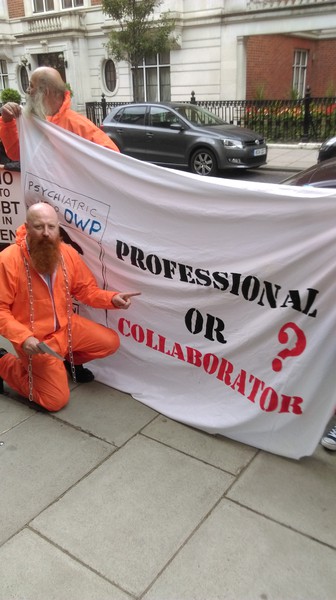
I joined comrades from the Mental Wealth Foundation and other organisations on the 5th July to demonstrate outside the Hallam Conference Centre in London, where the New Savoy group and members of the big five psy organisations were meeting. These five organisations were: the British Association for Behavioural and Cognitive Psychotherapies, the British Association for Counselling and Psychotherapy; the British Psychoanalytic Council, the British Psychological Society and United Kingdom Council for Psychotherapy. We called on them to refuse collaboration with the Department of Work and Pensions and the unethical provision of psychological treatments by its members. We called on them to stop the unethical conflation of unemployment with individuals’ ‘psychopathologies’ needing to be ‘cured’ to make them fit work. This detracts from peoples real issues of mental distress, and detracts from the political and economic issues of why people become and are distressed.

I agree that work, the right kind of work, being able to work, rewarding work, and non-alienating work can be a good thing; however, work per se is destructive if it is under conditions of poor pay or zero hours contracts, or in conditions where human flourishing cannot occur. But this is the harsh reality of austerity fueled Tory Britain today; a reality where unemployment is now deemed to be the remit of ‘mental health’ services and psychological treatment. The psychological ‘treatment’ of worklessness is called psychocoercian.

Worryingly the DWP policy of psychoceoercian  appears not to be being criticised by the Scottish government, who dictate that work is a good ‘health outcome’. I wrote to the Scottish Government earlier this year to ask what their position was on the pernicious DWP policy of psychological treatment for being unemployed. Their response was simply:

… the Scottish Government recognises that work is an important part of people’s lives and can help to enhance health, wellbeing and quality of life, and people should have the opportunity of support to return to and remain in work… we aim to provide targeted support to help long-term unemployed people enter sustained employment.’ Quote from letter from Scottish Government to Dr Bruce Scott -30/06/16.

In London on the 5th July 2016 outside the Hallam Conference Centre, in response to psychocoercian, where ‘service users’ and psy professionals are being corralled into the service of neoliberal and austerity politics, comrades collectively cried: NOT IN OUR NAME!

‘I don’t like this place, Daddy’

DUNDEE SUWN WEEKLY REPORT, 4-8 JULY, 2016

‘I DON’T LIKE THIS PLACE DADDY’

16-07-04 Dundee

Bairns can be very perceptive, as the above comment, fae a wee mite emerging fae the gloom of Dundee jobcentre and into the summer sunshine, testifies. We weren’t able to get to the bottom of his problem with the buroo, but plenty of other people were only too willing to unburden themselves, in no uncertain manner. Traffic was, like last week, worryingly busy, with complaints regarding treatment at the hands of (Work Programme Provider)Triage dominating discussion. We heard from two people who had been sanctioned as a result of missing appointments at Triage – the single biggest reason for sanctioning that we come across. Andy is a middle aged man with blood clots in his legs, who had recently been bumped from ESA, and who had went through two previous sanctions. He was distraught at being sanctioned for missing an appointment he had not been given, had missed the deadline for appealing, and saw little point in doing so, anyway. In the course of chatting to us, Andy explained that he had previously appealed sanctions and had got nowhere. However, when we dug a little deeper it became apparent that he had only went through the Mandatory Reconsideration stage, and, when this was refused, had given up because he thought he had exhausted his options. We explained that he should have taken his appeal to an independent tribunal, where he would have a much better chance of winning, as his case would not be judged by a DWP ‘decision maker’. After further discussion, we urged Andy to consider a claim for PIP, as he complained of constant pain and restricted mobility due to the blood clots in his legs. We provided him with the PIP number and explained the application process to him, and provided him with info of welfare organisations that can help him with filling in the PIP form, which is absolutely essential as these forms are designed to trick and trip up claimants.

On Thursday, we also met a mother who was accompanying her 19 year old son into the buroo. Whilst he was too angry to talk, his mother explained that he had been sanctioned for two weeks for missing a Triage appointment, and had only just been informed that he had received another four week sanction, but with no reason given. Whilst they had been informed about hardship payments, they were unaware of how the appeal process worked. We explained the importance of appealing, and the consequences of not doing so – yet further sanctions, as you are marked as sanctionable. On Monday we had met Steve, in his late twenties, who reported that he had also been threatened with a sanction from Triage. He had phoned to re-arrange an appointment with them as it clashed with a community work appointment, which he was legally obliged to attend. He was informed by his Triage advisor that he was also expected to attend the appointment at the Triage office, and that if he didn’t he could expect to be sanctioned. We urged him to provide evidence of his community work appointment to Triage, along with a letter complaining about his treatment, and asked him to keep in contact for advice and to let us know how his case was going. In addition, we also heard from a couple of people who complained about being made to wait long periods for pre-arranged appointments at Triage, with waits of up to an hour and beyond being reported – this from an organisation (sic) that regularly sanctions people for turning up five minutes late to an appointment.

In other notable cases, on Monday we heard from Mandy, a young mother on IS, who had had her payments stopped when she was admitted to Carseview on two separate occasions over a month long period following mounting mental health problems. She was extremely upset when we met her, but we were able to calm her down, and provided her with advice on the appeal process – she was aware of the hardship payment scheme – and details of welfare organisations she could approach for more help, as well as urging her to raise the issue with her ‘key worker’ at the social work dept. Finding out that her claim had been closed, and the worry that she could not feed her children had hardly helped her depression, but she was in a better place after speaking to us. We could only shake our heads at the heartlessness of a so-called ‘welfare system’ that could treat vulnerable people in such a cold manner.

On the same day, we also met Steve, who is on ESA, but who had been urged by his social worker to apply for part time work. When he had found a job of 12 hours per week, he had been informed by the jobcentre that his ESA claim would be shut down. Steve, who suffers depression, was put into a tailspin by this news, despite the fact that these working hours are within the ‘permitted range’, so there was no basis for a sanction. We urged Steve to raise the issue with his social worker and to complain about the incompetence of his, so-called, ‘advisor’, and the stress and anxiety that this example of bureaucratic numptydom had caused him.

This is by no means exhausts the cases and inquires that we came across at our stalls on Monday and Thursday, which continued the rising pattern of traffic we experienced last week. It seems it might be a ‘long hot summer’ on the front line of the war against welfare reforms and the monstering of the unemployed.

Thanks to Susan, Sarah, William, Chris, Gary, Fuzzie, Jenny, Grant, Gordon and Tony for helping out at the stalls – all names in this report have been changed.


They take with one hand and take with the other

grabbing-hand-clipart-money_grabber

Last week we were contacted by someone who had taken one of our leaflets outside the buroo after just signing on to Universal Credit. He had just been dismissed from a long-term job and been paid a lump sum in lieu of three month’s work. He had paid quite a bit of tax on this, but been reassured that he would be able to claim the tax back, as indeed he will – BUT in the month he receives the tax rebate it will be ‘treated as employed earnings’ when they calculate his Universal Credit.  The same is true of repayment of National Insurance contributions. Clearly grossly unfair – and clearly laid out in Universal Credit rules.

On a more positive note, we also got a phone call from a man in Ayrshire who had just got back from two years working in another EU country and was having to rely on support from his father, as he had been told by the DWP that since he had been living abroad he couldn’t get any benefits for three months. After a long discussion with CPAG I was able to inform him that under EU coordination rules he should be able to get Income-based JSA straight away as his time working in the EU counts towards this. (The EU does have some uses.) He will have to put in a Mandatory Reconsideration and get temporary help if necessary from the Scottish Welfare Fund.

Too busy by half – SUWN weekly report

buroo 1

‘You should be here every day, that’s the most helpful they’ve been’

SUWN volunteers were back on duty following last week’s terrible guilty verdict against Tony Cox. Our stalls outside JC have been quite quiet for some time, and we had wondered if this was something to do with the long drawn out Euroref campaign. Whilst the jury is still out on that question, we can report that we came across more cases on Monday and today (Thursday) than we have for some time. On Monday we met Helen, a 37 week pregnant woman who reported that her Income Support claim had been shut down, and she was going into the jobcentre to find out why. She was very anxious about the prospect of facing an advisor on her own, and was clearly upset. We managed to calm her down, and a SUWN volunteer accompanied her in; after a fairly lengthy wait the problem was resolved and Helen’s claim was re-opened. Another volunteer accompanied a claimant in and reports, ‘I accompanied X in who had asked for support over a few issues. His ‘job coach’ was most reluctant to let me in on the interview: she protested that there was nothing on his record to say he needed anyone with him and told me to wait in the waiting area, but she had to relent when X insisted he wanted me there and I pointed out that this was OK by their own guidelines. I was therefore able to reassure X that he did not have to submit to their pressure to let them email Universal Job Match (UJM) links to him.

‘The jobcoach set up a new claimant commitment and X and I were both surprised that instead of stipulating a set number of job applications each week she insisted that it was the activities that he did to look for work that were important. While this is a shift in the right direction, the test will be what they consider appropriate activities, and I certainly didn’t get the impression that they were trying particularly hard to help make his job search productive (for example they could have volunteered information on updating his qualifications, rather than leaving me to request this.)

‘X had also received a letter saying that his benefit was being suspended, which had produced the predictable worries. He was able to confirm that all that had happened was a bureaucratic hiccup in registering his new address, but these letters are indicative of the callous attitude shown by the DWP to those who rely on their meagre dole. We met another person who had gone through similar concerns that same afternoon.’

The issue of advisors forcing people onto UJM continues to surface, as the above volunteer also reported, ‘We were rung up by someone we had given a leaflet to who had just signed on. He told us that he had been told to sign up to universal jobmatch at his initial phone enquiry before he had even come to the jobcentre. It was presented as part of the preparation for his first meeting, along with bringing all relevant documents.’

Also on UJM, Brian said that they tried to sell UJM to him by saying he ‘might not’ have to come into the jobcentre every month as they could check up on him online.’

At today’s stall we met Joe, a middle aged man who reported that he had just been sanctioned for three months. He only found out about the sanction when he went to try to get money out, and when he raised the issue with the DWP, he was told that the sanction dated from three months ago, but there had been a delay in the sanction being processed. Joe reported that he had received no notification of any sanction, and that he doesn’t know why he was sanctioned – neither was he informed about his right to apply for hardship allowance. We urged him to complete a mandatory reconsideration and to contact a welfare rights organisation to help him with the appeal he will have to go through when his mandatory reconsideration is, inevitably, refused by the DWP decision maker. We regularly come across many people who give up on the appeal process following the rejection of their MR, as they mistakenly believe that the MR constitutes their appeal; always remember that the MR is only the first part of the appeal process.

We came across another sanction issue today, which further underlines just how the introduction of the MR has reduced the number of appeals that are successful; Fiona is in her thirties, a single parent with an eleven-year-old bairn. Just over a month ago, she received a text from Triage saying that an appointment she had had been cancelled, only to be informed today that she had been sanctioned for three months. She also reported that she had been sanctioned last Xmas and at Easter, for one month on both occasions. Fiona, like many others, was not aware that the MR was not the end of the appeal process, and when she had been told that her MR had failed on the previous two occasions, she had not taken her cases any further. When we met her she was clearly upset and close to tears and declared that ‘there’s nae point, they always win’. We explained how the appeal process works and urged her to fight the sanction. After a lengthy chat during which we reassured her that it WAS worth her while to fight she agreed to phone in her MR, and to get in contact with a welfare rights organisation when it came time to appeal. She left us much happier than when we had found her, which by itself is justification enough for the work we do.

In addition to these sanctions, we also came across Alan, a single parent with a bairn of eleven, who, after an extended period of ill health had been told that he should shift from JSA to ESA. He made the application for ESA, but was not informed that he had to close his JSA claim. As a result, he had received no money for three weeks, and when he had made inquiries was informed that he had to open another ESA claim, and that he would miss out on the three weeks money he was due. We urged him to complain and to claim JSA money back, and gave him details of welfare organisations that could help him. We also came across a number of people who had recently been bumped from ESA to JSA, and this was causing no end of anxiety and stress. This issue needs to be addressed as matter of priority as it benefits no-one to have people who are palpably unfit to work declared as such by jumped up assessors who often fragrantly ignore medical evidence and who misrepresent the words of those they are assessing.

All in all, this week’s stalls were a bit too busy for our liking, which underlines that we must remain vigilant. On a more positive note, we received a visit from Bennie, Shauna and (new) baby Jacob, which gave rise to much oohing aahing on the part of volunteers and passers-by alike. We can only hope that by the time baby Jacob is of age that these inhuman, sulphur smelling, so-called ‘welfare reforms’ will be a dim, but still nasty memory. We aim to ensure that is indeed the case.

buroo 2

Thanks to both Sarah’s, Chris, Grant, Gordon, John, Fuzzie and Tony for helping with the stalls on Monday and today. The names of all people in our report have been changed.


Class ‘Justice’


16-06-23 Dundee Sheriff Court

We always said it all depends on the sheriff – and we were right. Today SUWN activist, Tony Cox was found ‘guilty’ of ‘threatening behaviour’ towards  the lovely folk at the Maximus Work Capability Assessment Centre in Dundee, who were preventing him from accompanying a vulnerable woman to her assessment. As Sheriff Griffiths explained in his verdict, it was a question of whose evidence he preferred – and he preferred the evidence of the crown witnesses. Prefer was his term. Never mind that their evidence was riddled with (unchallenged) contradictions over what happened when and even if the police came into the building (they didn’t). Never mind that the woman Tony was accompanying insisted, despite persistent leading questions from the Procurator Fiscal, that Tony did not ‘swear’ or ‘shove’ the receptionist at the door.

We have always said that this should never have gone to court. That if the police had only stopped to ask the other side of the story before whisking out the handcuffs, this whole sad spectacle could have been avoided. And now we are facing the consequences of what passes as a justice system but seems as much concerned with searching for truth as the competitors in a debating contest.

The Fiscal’s portrayal of Tony as just there to cause trouble could not have been further from the truth. While we have emphasised the wider significance of this case, his reason for being at the Maximus Assessment Centre was simply to accompany a vulnerable woman who had specifically requested that he be there with her at her assessment, as he had done for other people before. On one previous occasion the assessor had asserted he could not take notes – and when he insisted on his right to do this and proved that it was permitted in the regulations, the assessor had called the police on him. On that occasion nothing went further, but that assessor had nursed her grudge against him, and it was her who insisted this time that he leave.  This time she asserted – again without evidence – that he had been banned from the building. Tony had insisted on taking this up with a manager and on his client’s right to be accompanied by a person of her choice. What the Sheriff chose to see as the Maximus receptionist being solicitous for the understandably distressed client, was actually her trying to persuade this vulnerable woman to go into the assessment alone, without the person she was relying on to help her; and – not incidentally – trying to persuade her that Tony was not her friend. Three Maximus employees were trying to prevent Tony from a simple bit of advocacy, while attempting to demolish his character in front of his client. And Tony tried to argue his case. He has a strong voice (after decades of public speaking) and he used it. But speaking loudly, and even raising your voice, is not a crime – yet. There was absolutely nothing on the CCTV footage to suggest behaviour that could be conceived as ‘threatening’: indeed he was mostly seated and generally leaning back in his seat too. He was there to represent and help someone and he was being careful not to compromise her situation or his ability to help others in the future. When he realised that they were getting nowhere and his client was anyway too distressed for an assessment, he left the waiting room, but he then found himself having to put his foot in the door to prevent the Maximus employees from keeping his client inside and continuing their pressure on her to go to the assessment without him. Far from him ‘shoving’ the receptionist, she was trying to kick his foot out of the way. And that charge of ‘shoving’ only got added to the original charge of ‘threatening behaviour’ in the course of the first part of the trial, which meant that there was not time to for us to challenge the lack of CCTV footage for that critical moment.

That this can have developed into a criminal case with a guilty verdict is simply a travesty. Tony was giving his time to help someone through the thicket of a punitive government bureaucracy – and even when he was arrested the SUWN made sure that she got the help she needed to get her ESA – but now another part of that bureaucracy has determined to punish and criminalise him.

This is part of a pattern. Arbroath Jobcentre had earlier tried to accuse Tony on a similar charge, but their evidence fell apart in court and the charge had to be withdrawn. And we have heard from people going into Dundee Jobcentre how the staff there do their best to tar the reputation of Tony and of the SUWN more generally. In Edinburgh, High Riggs Jobcentre has several times called the police on advocates from Edinburgh Coalition Against Poverty.

Anyone who had any illusions in our ‘justice’ system would have had them knocked out by observing this case; but the verdict was just the beginning. As the Sheriff and the lawyer parleyed over issues that might affect the sentencing, Tony felt compelled to protest that the sheriff had misquoted him, and when asked if he was ‘fit for unpaid work’, he replied that he already did community work. For the sheriff this was tantamount to insurrection. Sentencing has been postponed for four weeks so that they can get a Criminal Justice Social Work Report. And Tony has been told that if he doesn’t grovel and accept his ‘guilt’ and if he doesn’t demonstrate his ‘empathy’ with the Maximus employees who shafted him, he can expect a harsh sentence. Because, in the sheriff’s words, his ‘antipathy to authority was clear’. We certainly didn’t see anything today to persuade us that the authority of our legal system deserves anything other than antipathy.

Just as people on the receiving end of the new punitive ‘welfare’ regime are expected to take responsibility for not being ‘positive’, so the criminal justice system is determined to punish people for not being sufficiently servile – and the sheriff made it clear that he was not happy with Tony’s body language or facial expression. In our Brave New World you mustn’t raise your voice and you must take your punishment with a smile.

Well that’s their world – and in the real world where the rest of us live there is more work to do than ever, and Tony and the SUWN have no intention of taking a step backwards in our advocacy and in our campaigning. As if to remind us, within five minutes of sitting down for a drink after we left the court we had two phone calls from people asking for our advice. The DWP and their friends don’t like what we do because we are getting results. We are helping individuals to navigate through their traps, and we are drawing attention to what is wrong with the system. (In fact we heard another example of the cruelty of the system as we were protesting outside before the trial began. A man going past told us that he worked in a Universal Credit call centre and that people would ask him how he can sleep at night doing such a job. He told us that he often can’t and that he is desperate to find other work.)

Yet again we can take heart from the solidarity shown by our comrades – by our friends in Dundee and our friends in Glasgow Anarchist Collective and Edinburgh Coalition Against Poverty who traveled across Scotland to be with us, and by all those who have contacted us from across the UK to show their support for Tony and for the wider fight for real justice. Together we will win!

These videos (by Glasgow Anarchist Collective) show Tony talking while waiting for the verdict and after sentencing.

Psycho-coercion and workfare: fighting back

This talk by Lynne Friedli of Boycott Workfare was given to an SUWN public meeting in Dundee on 7 June. You can watch it here on youtube.

Lynne is a researcher with a special interest in mental health and social justice. She wrote: ‘I’m going to talk about the rise of psychological fundamentalism and what it means for people claiming benefits.

‘My main theme is psycho- coercion in workfare: the use of psychological interventions to discipline and punish claimants (for example mandatory training, psychological referral, psychometric testing , psycho-sanctioning e.g. for lack of motivation). But I’m also interested in thinking about psychology’s role in imposing the work ethic. The contribution of psychology to moral mantras of ‘work is good for you’ and the ‘work cure’ and the similarities in psychological coercion experienced by both claimants and workers, especially precarious workers, ‘negotiating the border zone between work and welfare’. As unemployment has become ‘job seeking’ – so job seeking – the pursuit of ‘employability’ – has become a career in itself. One that is supervised, scrutinised and managed by the private contractors of the welfare to work industry and also heavily promoted by public health. What is also clear is how narratives of institutional psychology are being used to undermine resistance to work and the legitimacy of ‘refusal to work’. So, the use of psychology in state attacks – economic and ideological – on refusal to work.

‘These developments – the rise of psychological conditionality, the creeping merger of health and employment, permitting the state to set therapeutic goals – raise profound ethical and human rights issues. Using examples of direct action in England by groups like Boycott Workfare, Recovery in the Bin, Mental Health Resistance Network and Disabled People Against Cuts, I hope we can discuss what fighting psycho-coercion means for political struggle. How we can escalate resistance to psycho-coercion in struggles around workfare, but also in the fight for better pay & conditions, as well as in the resurgence of anti work politics.’

Message of Support from Paul Laverty

We have received the following message of support from Paul Laverty, screenwriter of I Daniel Blake, directed by Ken Loach, the film that won the Palme D’Or at the Cannes film festival:
“When we were researching the material for I Daniel Blake we came across overwhelming evidence of vulnerable people subjected to great pressure both by the Department of Work and Pensions (DWP) and indeed the subcontracted companies carrying out the work capability assessments. On a trip to Dundee I personally witnessed Tony Cox and his colleagues at the Scottish Unemployed Workers Network giving solid practical advice to confused and sometimes highly distressed claimants. I have spoken to doctors who have been infuriated by the treatment of some of their patients who have been deemed fit for work despite serious illness. In this context the work of Tony Cox and his colleagues who accompany vulnerable claimants is a great service to the body politic. They are doing this on a voluntary basis, at no charge, because they are principled citizens who refuse to stand idly by while their neighbours are often bullied. Claimants have a right to be accompanied by an advocate of choice and if this right was respected in full by the DWP citizens like Mr Cox would not be in the dock, and a great deal of public expense would be saved. I have no doubt that the senior management of the DWP are determined to punish anyone who stands up to them; and once again, the vulnerable client, who was so upset that she could not continue to give evidence at the last court hearing now has to repeat the ordeal once again; one more person to the long list of those who have suffered unnecessary misery at their hands. DWP managers, shame on you. ”

Ken Loach Palme D'Or 1160 x 650