Nursing oor wrath tae keep it warm

stall-1

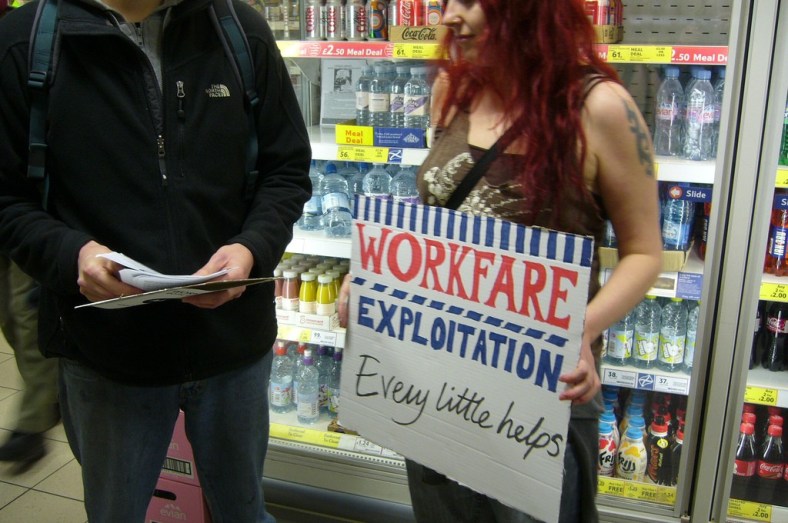
The phoaties dinna really gie an indiciation oa just how Baltic it wis yisterday at the SUWN advice and leafleting stall in Dundee, to prepare for the free screening oa ‘I, Daniel Blake’ on Wednesday nicht. We wir able to noise the street up a wee bitty, courtesy oa Ailsa, Chris and Duncan geen it a bit oa laldy oan the megaphone. Despite the streets being pretty quiet, we still dealt with a couple oa cases, including Bella, a 56 year auld wummin wha’s recent marital separation meant she has ended up living in a homeless shelter, and trying tae get by oan aroond £80 a week, fifty odd oa which she hands ower to the homeless shelter. She is suffering fae a number of medical conditions, including epilepsy, high blood pressure and Sciatica, but when she contacted DWP help line, she was very unhelpfully informed by the advisor that applying for ESA wid be a waste oa time – not only is this advice wrang, we believe it is culpably wrang, and that advisors are being directed towards a course oa action aimed at limiting the number of successful social security applications. If you intend applying for PIP or ESA we would advise that when you phone the respective helplines, on 0800 917 2222/0800 055 6688, to request that a application form is sent to you, you should avoid completing the form on the phone – tell the advisor that you have problems using the phone and that you need face to face help with filling it in, otherwise your’e likely tae get the same treatment as Bella.

The top phoaty shows Ailsa checking her lines, and Gary trying tae levitate the SUWN stall using the skills he’s gleaned fae the Paul Daniels big book oa magic he goat fir Crimbo, whilst the ither phoaty shows Gary, Jock, Sarah and Ronnie indulging in a bit oa synchronised shivering. Thanks to Norma, Duncan, Chris, Gary, Ailsa, Jock, Ronnie and Tony for braving the cauld.

stall-2

Resisting the new normal

mushrooms

I am worried that people are getting so used to be treated like mushrooms that they have forgotten to demand anything else. You know, the kept in the dark and thrown handfuls of shit thing. A lot of people come out of the jobcentre and tell us everything is OK, and then you meet someone who has been struggling through six weeks with no money waiting for his Universal Credit to come through because no-one told him he could get an advance and get help from the Scottish Welfare Fund, and you wonder how many more people are in the same situation but have just accepted it as the new normal. Or you meet people wasting hours and days on the DWP’s next-to-useless Universal Jobmatch, because they hadn’t known that it was not compulsory to agree to this unless specifically directed. Or you meet someone who wants to confirm that the unpaid ‘work experience’ that they have been offered is not actually compulsory, and you realise that many people don’t dare ask questions. but just do what they are told and go where they are sent. Or you talk to someone who is concerned about what they are being made to sign as a Claimant Commitment, and think how many people just sign what they are given without comment. As we have observed before, although sanctions are – thankfully – much less common than they were, the fear of sanctions is as potent as ever, so they are still performing their disciplinary role. Newspapers highlight the worst cases of DWP abuse, but this constant erasure of expectation and hope can slip under the radar. We can’t let that happen.

2016 – a year with the SUWN

Hogmanay, the beach and firelight

Comrades, sparklers, soup and beer

First new blog in brand new website

Starting off the brand new year

January

IMG_1375

Make us work but pay no wages –

local  centre, big rich store –

Name and shame on public pages

Activists outside the door

February

Range 1

Range boss boasts of making profit

Work for nothing and he may

Give a job – we say ‘come off it!

Fair day’s work for fair day’s pay!’

March

IMG_1672

Few days early, march for May Day

Folk in jobs and unemployed

‘Spite the differences on payday

All exploited, all annoyed.

April

At the Range to protest workfare

Joined by Dundee TUC

Outside centre where the day care’s

Done by unemployed for free

May

advocacy-is-not-a-crime

Tried to help an ESA-test case

Staff ganged up and said ‘get out!’

Judge decreed ‘they have the best case’

Status gives no room for doubt

June

boycott-workfare-logo

Down to Manchester to meet with

Others fighting Thatcher’s curse

Folk to fight beside and greet with

Scotland’s bad, but England’s worse!

July

Maximus hanging figures

Triage still a sanctions factory

No note of meeting – ‘no excuse!’

Maximus not satisfactory –

Disability abuse!

August [Triage are a Work Programme provider subcontracted to the DWP, Maximus administers the Work Capability Assessments]

img_2963

Two years on and we’re still fighting

To escape from UK rot

Plus petitioning in writing:

‘Make the best of what we’ve got’

September

Triage worst in all the nation

For its callous attitude

We decide an occupation

Demonstrates our gratitude

October

i-daniel-blake

People ’cross the land are crying

For the fate of Daniel Blake

Tory’s protest, ‘it’s all lying,

He’s not real’ – He’s no fake!

November

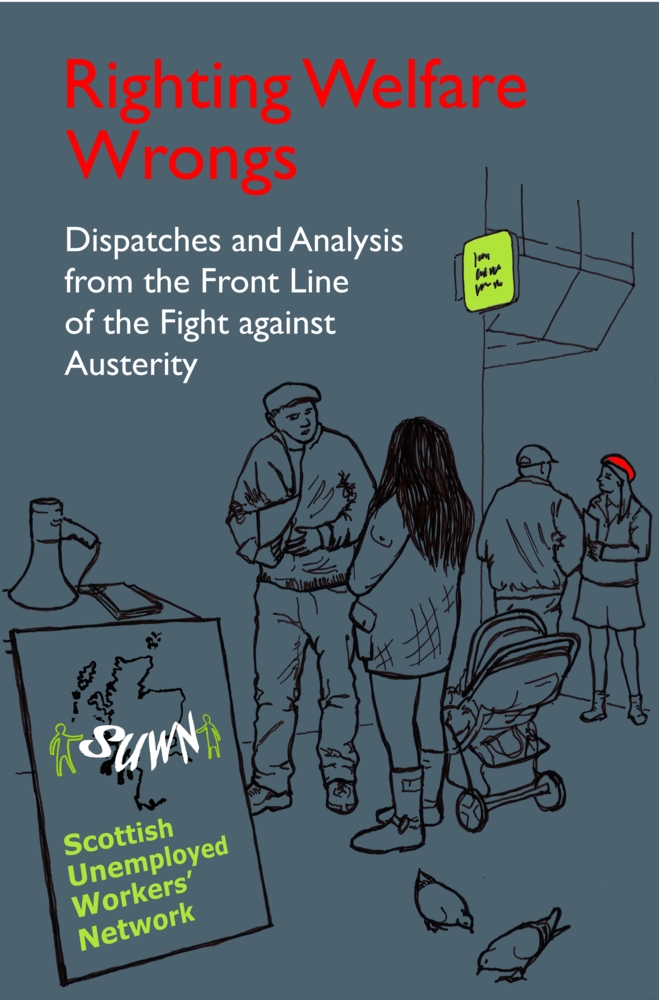
suwn-cover-drawing-small

If you’ve not had in your stocking

Our new book on why and how

British ‘welfare’ state’s so shocking

Not too late to order now!

December


Paperback £10 or download for FREE

HAPPY NEW YEAR EVERYONE!


Waiting for Maximus


maximus-busy

Yesterday, David accompanied Isobel to Cadogan Street for her Work Capability Assessment. Nothing remarkable about that – except that this was the third time that they had made the journey. Isobel contacted us in July when she was waiting for her appointment – and then again in October when she had finally heard that they would see her on 1 November. So we made arrangements, and she made arrangements, but then, as David explained:

‘Isobel’s assessment was postponed due to the amount of time she was forced to wait in extreme discomfort. They knew about her injury and still kept her waiting, with the modern excuse of the “systems” were down. Eventually she felt she could no longer cope with the pain and, despite being “assured” it wouldn’t be long if only we’d wait, she postponed and a new appointment time for assessment is being sent out. They did say next time she’d be a priority. Nearly £5 on parking tickets and a lot of pain for nothing, and they definitely don’t like advocates much either. Very glad I was there as I feel they would have had her waiting all day. A “manager” came out to apply some pressure after I said we’d have to postpone.’

The new appointment was on the 23 November, and we made arrangements and she made arrangements but – as David explained:

‘Cancelled again!! This time after an hour of waiting in severe pain and discomfort only to be told the specialist she was due to see had left after a busy day. Isobel was meant to be a priority today, however the manager who’d assured us of that last time seemed not to remember saying that, and was again fobbing us off by telling us she’d be seen “shortly”. An hour later, and a different lady with a very apologetic nature gave us the news the specialist had left and Isobel will have to come back again. Told her I appreciated the apology but it’s not good enough and this would be the 3rd appointment made for someone in extreme pain. Noticed the words “priority” in black pen on her file so the manager appeared to be lying through his teeth. At this point a few people in the waiting room who were still to be seen started crying, as did Isobel . Shocking display of contempt for their “clients” and appalling mismanagement.’

Yesterday was third time lucky – at least as far as moving beyond the waiting room was concerned…

Shocking though this account is, it is, in fact, not particularly unusual. Although the person applying for ESA – who by definition has health problems – is expected to get to their appointment on time or provide very good reason, the assessment centres are always cancelling at the last minute. Sometimes they manage to let people know before they actually turn up – though after they have suffered the anxiety of preparation; and sometimes, as in Isobel’s case, they only find out after they have already been waiting. But this callousness is symptomatic of the whole way ESA is administered.

*             *             *

It’s been fairly quiet outside Dundee jobcentre recently, but our chilly stall today demonstrated a distinct lack of Christmas spirit within those walls.  One person told us that despite a previous agreement that she could pay back a loan in small increments, the jobcentre had taken it upon themselves to deduct £46 a week from her benefits (we advised her to ask Welfare Rights or CAB to renegotiate this). Another said that he had been told that he could get his interview travel costs repaid at a standard mileage rate, but that they then only allowed him the cost of the petrol and made him pay back the difference (we advised him to put in a complaint). And another person told us that he lived in Brechin and his doctor was in Dundee, but when he handed his doctor’s line into the jobcentre in Dundee to be scanned they grumbled that he should be taking it to Forfar, which is 11 miles from Brechin and 14  miles from Dundee.

Happy Christmas!


Over a barrel


universal-credit-claimant-commitment-p1-of-4

The Claimant Commitment is presented as though it were a contract agreed between two freely consenting parties, but that is far from the case. If you don’t sign the Claimant Commitment that the jobcentre has prepared for you then there is no benefit money, so your negotiating position is pretty fatally undermined from the start. There is provision to get a second opinion, but only from another jobcentre worker who can simply back up their colleague – as these two cases demonstrate.

John, from central Scotland, contacted us last week. He was not unnaturally concerned that the document he was being made to sign effectively required him to promise to do anything he was asked by his ‘jobcoach’ or by the Work Programme. He will have to sign this to get his benefits – though he can push for a change in the wording afterwards. This is bad because it increases the risk of a sanction and of all the worry that goes with that risk, but if he does get sanctioned his Claimant Commitment shouldn’t actually affect the legal requirement that all demands made of him should be reasonable and that everything that is actually mandatory should be clearly signalled as such. If what he is asked to do doesn’t fit these criteria, then he should win an appeal – but only after he has gone through the inevitable hardship first (see our advice on Universal Credit). And he can still refuse to sign documents given to him by his Work Programme Provider because that is a data protection issue (see our advice on surviving the Work Programme).

Aisha’s case from the west of Scotland shows the jobcentre using its powers to carry out much more flagrant abuse – in fact, in this instance, clear religious discrimination. The Claimant Commitment is meant to be a general agreement rather than anything to do with specific jobs, however Aisha’s jobcoach, who has given her trouble in the past, included a requirement that Aisha attend an open day for a particular company. She included it because she knew Aisha didn’t want to go, and one of the reasons she didn’t want to go was because it was primarily a debt collecting firm and lending money for interest is not allowed in Islam (Incidentally, the jobcentre is supposed to respect ethical objections too, not just religious ones.) Aisha refuse to sign the document and her benefit was stopped. She has now had to reapply for Universal Credit and go through the initial waiting period all over again. To make it worse, though the jobcentre told her when she asked that by not signing the Claimant Commitment she wouldn’t jeopardise the benefits she was due before that day, this was not actually the case. Universal Credit is worked out on a monthly basis so she ended up receiving no payment for the previous three weeks too. In fact she has now received nothing from the DWP since the beginning of October, and although the Scottish Welfare Fund has enabled her to keep going, this hasn’t covered the rent, and she is being threatened with court proceedings for eviction. She has submitted both a Mandatory Reconsideration letter and a complaints letter about the way her previous claim was ended and she was hoping that her payment would come through by the end of the week – but everyone she speaks to at the DWP gives here contradictory information and advice for every question she asks.

(Thanks to our good friends at Edinburgh Coalition Against Poverty and the Child Poverty Action Group for their help with these cases.)

National Audit Office criticises DWP Sanctions

national-audit-office

The National Audit Office has just produced a critical report on Benefit Sanctions. Of course they were only looking at sanctions within the official dialogue of getting people into work – where we all know they score very badly. But sanctions were never really about this. After all, there aren’t enough jobs. What the NAO doesn’t discuss is the unspoken agenda, where sanctions have proved very effective in disciplining people on benefits and in helping to create workers who dare not protest about their pay and conditions for fear of ending up unemployed and potentially destitute. You don’t even need to keep sanctioning people at such a high rate to achieve this – just enough to maintain a fear of being sanctioned.

Nevertheless, the NAO’s criticism provides an important tool with which to attack the credibility of this pernicious system – and DAVID WEBSTER has provided a summary of the KEY POINTS:

*  The report is generally critical. It uses a ‘traffic light’ scoring system. On sanctions, DWP scores:  red 2, red/amber 1, amber 3, amber/green 3, green 0. (Figure 1, p.11, Figure 8 p.21 and Figure 20, p.38)

*  A recurring theme is the lack of evidence to support the sanctions regime, and the DWP’s unwillingness to make use of its own data to evaluate it or to collaborate with outside researchers. The report is particularly critical of the DWP’s reliance on ‘international evidence suggesting that broadly some form of sanction has an effect’. (para.23)  It repeats the call for a wide review of sanctions made repeatedly by the House of Commons Work and Pensions Committee. (para.24)

*  Using Work Programme data, the NAO did its own analysis of sanctions’ employment effects. This found that JSA sanctions had a large effect in getting claimants off benefit, but they were as likely not to find work as they were to find it. There was no positive effect on earnings for those who found work.

*  The report finds that ESA sanctions actually reduced claimants’ likelihood of working. This bears out the findings of the important report by Catherine Hale, Fulfilling Potential? ESA and the fate of the Work-Related Activity Group (2014).

* The report finds that the rise and fall in referrals over the period 2010 to 2016 cannot be explained by changes in claimant behaviour. (para.13, p.8) This supports the conclusions of my analysis published at www.cpag.org.uk/david-webster, although in other respects the conclusions are different.

* The report comments that sanctions are not rare. It finds that of all people who claimed JSA at any point between 2010 and 2015, 24% were sanctioned, before challenges. (Figure 5, p.16) The only previous published figure of this type (in FoI response 2014-4972) showed that 22.3% of the 8,232,560 individuals who claimed JSA over the five year period 2009/10 to 2013/14 inclusive, were sanctioned, after challenges. After allowing for the pre-/post- challenge difference, these figures are similar (about 10% of sanctions were overturned over these periods). DWP ministers and officials have deliberately and persistently misled politicians and the public by quoting the monthly sanctions rate of around 5% as if it meant that only 5% of claimants are ever sanctioned.

* The NAO report explains why the DWP hasn’t been publishing statistics on Universal Credit sanctions: it hasn’t been collecting them. Only from Sept 2016 has the DWP been recording whether UC decisions relate to sanctions or to other matters. (Note 4, Figure 2 p.13)

* The NAO report does not give statistics on Universal Credit sanctions, but it does show that the sanction referral rate for UC, at 11.7% of claimants per month, is approaching twice what it is for JSA (6.5%) (Figure 2, p.13) This implies that the UC sanction rate is also likely to be double that for JSA. The report also says that decision making for UC sanctions is understaffed, with 42% of UC sanction decisions in August 2016 taking more than 4 weeks while 90% of sanction referrals for other benefits are decided within 5 working days.

*  In August 2015 the UK Statistics Authority made recommendations to DWP for improvement of its sanctions statistics and removal of misleading aspects including the misrepresentation of the proportion of JSA claimants who are sanctioned. Very little has happened since and the NAO report urges DWP to get on with implementing the UKSA’s 5 recommendations, which are listed in para.3.5.

* The NAO finds that some Work Programme providers make more than twice as many sanction referrals as other providers within the same geographical area, even though claimants are randomly allocated so that the caseload characteristics are identical for each provider. (para.2.12) It finds that where providers referred more people for sanctions, they had a worse employment performance. On average, the best provider in an area achieved 6% more employment outcomes and its participants received 20% fewer sanctions. (Figure 22, p.42)

* A particularly embarrassing finding for DWP is that it applies sanctions to a similar proportion of referrals from every Work Programme provider, whether they have a high or a low referral rate – in other words, while some providers are making an assessment of whether they should make a referral, DWP is not making genuine assessments of whether claimants should be sanctioned. (para.2.12 and Figure 13, p.29) Not surprisingly therefore, the report also finds that 26% of Work Programme sanctions are overturned compared to 11% of those imposed directly by Jobcentres.

* The NAO estimates that the amount of money not paid to claimants as a result of sanctions (sanction value minus hardship payments made) was about £97m in 2015. On the basis of a straightforward pro rata calculation, this supports the estimate of £332m which I previously made for 2013/14. The difference is due to the big fall in sanctions between 2013/14 and 2015.

*  DWP has made no overall assessment of the costs and benefits of the sanctions regime including on other public services and should do so. (para. 3.20)


Triage strikes again

triage-logo

Triage seem to be keeping up their exemplary level of abuse. On Monday we met Steve who couldn’t understand why his ESA had been stopped. He is on the assessment phase: he has submitted his detailed medical form (ESA50) and is still waiting for a Work Capability Assessment. He had already had problems with his form getting lost in the system and miraculously found again, but all had seemed OK and his doctor’s lines were up to date. Only, his money never appeared in his bank account. With no credit in his phone, he went to his mother’s work-place, and after an hour-long phone call with the DWP was again told that they didn’t have his form, and advised to go to the jobcentre. I went with him into the building, and a remarkably helpful, if slightly puzzled, advisor looked up his case and told us that his claim had actually been shut down as the Work Programme Provider, Triage, had reported that he had failed to do something. Steve explained that last time he had been in the jobcentre his advisor had told him that since he was now getting ESA and had a doctor’s line he no longer had to go to Triage, and that she would inform Triage of this fact. So either she never passed on this message, or, as has happened so often in the past, Triage took the message and ignored it. He would now have to appeal against the stopped claim, but the woman who was helping us suggested that it might still be possible to get Triage to rescind their complaint. So off we went down the road to Triage. On reflection, it would have been better for someone else to have gone with Steve. As soon as they saw me they panicked and refused to let us in on the grounds that I was going to occupy the building again. I told them that I would go so they could see Steve without me, but even with me gone, they refused to let him in, and then laughed at his predicament.

We have made contact with Welfare Rights who should be able to get this resolved, and we were able to sort out immediate help in the form of a food parcel and an application for a Scottish Welfare Fund Grant. Although Steve was understandably angry, he was not surprised, as this had not been his first experience of Triage’s interpretation of ‘supporting’ people into work.

At least we didn’t have to listen to Osborne


hammond

The best thing about the Autumn Statement was not having to listen to Osborne’s uber-smug tones. The section on welfare was very short, but then there is not much left to cut.

After all the talk about Just About Managing families, there had been some hopes raised that the government might reverse the effective cuts for people moving from Tax Credits onto Universal Credit, but those hopes were soon crushed (cue headlines about ‘no JAM today’). Remember all the excitement about Tax Credit cuts being rejected by the House of Lords? Well, it was only ever a delay, as the move from Tax Credits to Universal Credit is bringing the cuts in by the back door. The one positive change is a very small drop in the taper rate for people earning and on Universal Credit. Instead of losing 65p in benefits for every pound earned, they will lose only 63p – which is still an incredibly high effective tax rate. Even IDS has protested that this change is not enough. For the people who will be losing thousands of pounds through the move from Working Tax Credits to Universal Credit, the change in the taper will restore only a few hundred. Meanwhile, the rise in the minimum wage is actually less than would have been expected if it is to reach £9 by 2020, as Osborne had previously promised.

And though pensioners retain the triple lock for now (i.e. the manifesto promise to increase the state pension annually by 2.5 per cent, or in line with inflation or wage growth – whichever is highest), there were clear indications that this is in the government’s sights for after 2020.

Even within its own terms the government yet again failed to meet its fiscal targets – which it solved by moving the goal posts. This move is fraught with potential danger, as Richard Murphy explains:

‘…we learned fiscal rules can be abandoned with impunity as Osborne’s were rejected without a backward glance. That which replaced it was worse though in many ways. First the books will be balanced, but we don’t know when. So that’s austerity forever. Second, debt as a proportion of GDP will shrink. That’s a licence for privatisation. Third, benefits [i.e. total benefit spending] will be capped. This is a plan for continued shrinking of the state at cost to ordinary people, and the social safety net.’ And Murphy describes the proposed investment in infrastructure as ‘peanuts’.


Jobcentre zealots

ecap-protest-intesco-3-marchJust a short posting from last week’s stall as it was mercifully quiet. However we did speak to one woman whose ‘job coach’ seems to have taken on board the DWP mission so thoroughly that she is never off duty. So enthusiastic was she about the benefits of unpaid ‘work experience’ that she stopped the woman when she saw her in the street to try and persuade her to take up a ‘work experience’ opportunity. Even if well-intended, this seems to us far from professional and akin to harassment. The woman has recent experience in retail and was far from enthusiastic about working for nothing in Tesco’s café. We were able to reassure her that ‘work experience’ is not compulsory and that it should be made clear if any activity is mandatory and sanctionable (if in doubt ask). And we agreed that anyone working for Tesco should be paid by Tesco. (The picture is from an Edinburgh Coalition Against Poverty protest in 2012.)

We also talked with someone who had had a temporary job at The Range and told us that reading our posts about the extensive use of ‘work experience’ there made her realise why they had had no need to take her on permanently. In fact, she said they were clearly doing their best to get rid of all long-term employees. She described the strange atmosphere on paydays, when some of the staff received their brown envelopes but the people on benefits who had been working alongside them got nothing.

And talking of over-diligent job-coaches – we received this account from a friend in Glasgow:

‘Was threatened with a sanction for being 3 mins late the other week by my new advisor. The next-time I signed on I was asked why I never turned up for my last signing as she had failed to put through my details!! Lucky I had brought the letter threatening my sanction which was proof of my attendance. No apology just more stress.’

SUWN response to the Consultation on Social security In Scotland

scottish_parliament_from_salisbury_crags

This is our response to the current Scottish Government consultation on the (limited) soon-to-be-devolved welfare powers. This consultation doesn’t include the schemes that are replacing the Work Programme as they are covered by a different minister. We addressed these in our recent letter to Jamie Hepburn. Thank you to everyone who signed our petition, which we have included with the response – and thanks to our activists for promoting it (especially Ronnie, who would win the prize – if there was one).

CONSULTATION ON SOCIAL SECURITY IN SCOTLAND, A RESPONSE BY THE SCOTTISH UNEMPLOYED WORKERS’ NETWORK, OCTOBER 2016

Thank you for setting up this important consultation. We are glad of the opportunity to make known our views, and hope that the Scottish Unemployed Workers’ Network can contribute to the on-going discussion on policy development and take part in the planned ‘user panels’.

PIP Assessments

We are very encouraged by the discussion so far on changing the nature of the PIP assessment process away from the current tick-box, try and catch you out and show you are faking, approach back to one based on evidence from a person’s doctor and other social services. We hope assessors will be able to be flexible as to the type of evidence they receive and that weight will also be given to the testimony of the claimant and their family and friends, as not all doctor/patient relationships are equally supportive.

We are sure that you are already well aware of the origins of the current punitive system, but feel it is important that it is not forgotten that the assessments used for both ESA and PIP were developed as a result of a long relationship, dating back to the 1990s, between the UK Government and a health insurance firm notorious for arguing that people’s problems were fake or psychosomatic and for not paying up on claims, and that they were deliberately conceived to remove large numbers of people from claiming the benefits.[1]

Evidence from GPs

We would also urge you to work closely with your colleagues in Health to ensure that claimants do, indeed, get the help they need from their GPs. Like you, we welcome the introduction of welfare rights officers into GP surgeries (so long as this is done with appropriate safeguards on patient privacy), but there are only welfare rights officers in a few places. In others, claimants for both PIP and ESA have to ask their GP directly for a supporting letter, and most GPs are charging for producing this. As benefit claimants don’t generally have the money to pay, they are putting in applications without medical evidence, severely affecting their chances of getting the money they need and deserve. As health is devolved, the Scottish Government have the power to intervene and make sure that people are getting free access to the support they need.

Advice and Advocacy support

While Scotland is much better provided with welfare advice than many places in England, we could benefit from increased investment in advice services, both face to face and over the phone, including more welfare rights officers in doctors’ surgeries and more stalls in public places such as shopping centres.  We would also like to see a positive recognition and encouragement of the role of friends and family and of volunteer citizen advocates and self-help groups  (like ourselves) in accompanying people to appointments, helping them ask the right questions and acting as witnesses to their encounters with an often unsympathetic bureaucracy. This should include prominent and clear recognition of a claimant’s right to be accompanied and for the person with them to be able to ask questions on their behalf if they require it. While such advocacy is already recognised in DWP rules, it is often denied in fact; but there could be a requirement for the rules to be prominently displayed in all Scottish offices, with contact details for an independent ombudsman. It should also mean that Police Scotland would not allow themselves to be used to shut down all questioning of DWP staff, as has frequently been experienced by both claimants and advocates, especially over the right to be accompanied. We have found that both the DWP and their subcontractors are very quick to call the police if anything they say is challenged, and that the police are very reluctant to listen to any other view of events. Better advocacy could also be assisted through the provision of a freely accessible, well publicised, telephone advice service dedicated to providing back up to the non-professional friends, family and volunteers who help claimants; something similar to the CPAG advice line for advisors, but more widely available.

Transfer from DLA to PIP

Of course many people have already lost out due to the UK Government’s insistence on instigating the transfer from DLA to PIP before the benefit was devolved. We would propose that after April no more people are transferred from DLA until the new systems are fully in place. We would also like to see the Scottish Government use its powers to provide additional help to assist those who have lost out through this transfer. We would recommend automatic reinstatement of mobility benefits lost through the cut-off for eligibility being dropped from walking 50m to walking 20m. We would also like to see additional help for people who have lost out on the transfer, perhaps through an enhanced Scottish Welfare Fund on a case by case discretionary basis.

Questioning decisions

A fairer initial assessment system should reduce the number of appeals, but we would ask in addition that the Scottish Government takes out the Mandatory Reconsideration stage, which primarily serves to delay the appeal process and to discourage people from taking their appeal through to conclusion.

A petition on key points

We have drawn up a petition that highlights five key points for the newly devolved welfare services – both those covered by this consultation and those under the auspices of the Minister for Employability and Training. We will send the 551 signatures by post as many are on paper, but the petition is reproduced below:

‘When more welfare powers come to Scotland, please can you make sure that:

  • No-one can get sanctioned for not attending or complying with any devolved ‘employability’ scheme, and this is made clear to everyone affected so that these schemes are effectively voluntary.
  • Scottish health services and other social and community services are kept completely independent of any DWP schemes that pressure people to apply for jobs. (We especially don’t want to see anything like the placing of ‘work coaches’ in GPs’ surgeries recently trialled in Islington).
  • The new Scottish PIP assessment process takes full account of evidence from health and other care professionals, and the GPs etc. have to provide this evidence.
  • Everyone who has lost benefits as a result of the cut-off for Higher Rate Mobility having been dropped from walking 50m to walking 20m can apply to get them reinstated.
  • There is no role for private companies in any devolved service.’

(We are emailing the pdf of the comments made on the online version of the petition along with this response)

Finally, we would like to give some additional responses to specific questions in the consultation that have not already been covered:

  1. Benefits should be provided in cash, but with the option of paying the rent directly to the landlord. There should also be options of using the benefit for reduced cost schemes e.g. for energy or mobility, and continued schemes for free public transport etc.

Digital applications should always be an option not a default expectation, and free phone numbers should be easily available.

Social services should be delivered through the public sector and should never be contracted out to private profit-making companies.

Third sector organisations should be seen as a source of additional help and not part of the public social security service.

  1. There should be some permanent independent body or ombudsman that one can approach with complaints and that could ensure that decision making is clear and transparent.

We would also like to see prompt publication of fully detailed statistics on claims/awards/appeals etc. (statistics not targets)

  1. (Please also see comments above)

Yes, there should be timetables set for assessments and decision making.

Yes, people should be asked to give consent to allow access to personal information including medical records as part of their application process; they should also be able to give consent to access some parts of this and not others.

In looking at the impact of a person’s impairment or disability, an assessment should include the impact on their ability to take part in social activity.

We are supportive of the idea of developing a consistent approach to disability benefits across all ages and ending the current arbitrary transfer from one benefit to another.

All assessments should be carried out by professionals within the public sector (see 3.)

People with long-term conditions should not have to undergo reassessment.

The option of reduced energy tariffs and other dedicated support is welcome.

We would like to see greater investment in public transport to help people more generally.

We support the continuation of some sort of motability scheme but are concerned that the present system may not always provide good value to those who use it.

  1. We are pleased that the Scottish Government is raising the Carer’s Allowance and hope that this is just the first step towards a Carer’s Living Wage. Caring is, after all, deemed to be a full time job.
  2. We are pleased that the extra help proposed for young people who have been unemployed is going to them and not to their employer, as schemes that pay the employer simply mean that younger people are taken on at the expense of those who are older.
  3. We are pleased to see that people in receipt of Universal Credit will be able to get this paid twice monthly rather than monthly, and that they will be able to choose to have the rent element paid directly to their social landlord. This should certainly be extended to private sector landlords. The risk of eviction is worse in the private sector and without those guaranteed payments, many private landlords will refuse to rent to people on Universal Credit at all.

We would like to see individual payments of Universal Credit as the default position. This could be crucial in any household where there is abuse, and also in cases where a partner has difficulties controlling their spending, e.g. through an addiction to shopping or gambling.

With respect to the housing element, one of the worst injustices that should be addressed is the meanness of the allowance given to single people under 35 who are in private rented housing. This is only enough to cover a room in a shared house, which is especially difficult for those who would like to be able to have their children come and stay.

  1. In looking at eligibility for PIP, any new system should be more responsive to long-term Scottish residents who have returned from a prolonged time abroad.
  2. We welcome the commitment not to recover overpayments that are the result of official error
  3. We are glad that you have acknowledged how relatively rare benefit fraud is and ask that all investigation is done so as not to create unwarranted alarm – unlike in the current system of random checks and computer-generated letters.
  4. Benefits should rise at least in line with the greater of the consumer price index or average earnings.[2]

canongate-wall-brookbank

This is one of the carved stones set into the parliament wall

[1] Foot, Paul (1995) ‘Doctor on Call’, Private Eye, 16 June 1995, reproduced here: https://beastrabban.wordpress.com/2015/04/13/private-eye-from-1995-on-unum-and-peter-lilley-in-the-tory-government; Rutherford, Jonathan (2007) ‘New Labour, the market state, and the end of welfare’ Soundings 36, Lawrence and Wishart; Stewart, Mo (2016) Cash not Care: the planned demolition of the UK welfare state, New Generation Publishing

[2] Unemployment benefits used to be increased in line with earnings or prices, whichever was higher, but since 1980 have been tied to prices, which have risen more slowly. Average consumption and living standards have risen with earnings, but people on benefits have been left far behind.