Farewell to 2017

suwn new year

Now is that time of the year again

Turning, we look back from here, and then

Think about all that is gone:

Standing in front of the buroo again

Helping folk know what to do, and then

Passing the info on.


Helping as folk are assessed again

Seeing their record’s not messed, and then

Making sure benefit’s won.

Put right DWP again

Again and again and again and then

Blogging on what we’ve done.


More baseless charges in court again

Helping ensure they are fought and then

Defendant’s still sane and strong.

Meetings and marches and rallies again

Sharing of knowledge with allies, and then

Proving the system is wrong.


Fighting ’gainst sanctions and workfare again,

Show working for nothing is unfair and then

Most so-called training’s a con.

Sending our MSPs mail again

‘Do all you can without fail, and then

Ask for the powers to go on!’


Responding to news with a letter again

Journalists now should know better, and then

Checking the story will run

Banter and coffee-warmed hands again

Beach picnic, drinks and live bands, and then

Activists too can have fun


Now is that time of the year again

Turning, we look back from here, and then

Think about all that is gone –

Two friends who won’t see New Year again

Hazel and Chris are not here – but then

Memories always go on

Had a seizure? – see you in court

law and medicine

When Work-Programme provider[*], Triage, got Anna arrested for threatening behaviour and assault last October, no-one bothered to find out that she had actually been undergoing an epileptic seizure. She doesn’t dispute that she banged her fists and grabbed at one of the Triage workers, but she had no control over her actions. The trigger for the seizure was frustration at Triage’s insistence on only notifying her of future meetings by post. She was concerned that she wouldn’t get the information in time and would end up getting her benefit sanctioned – and as we know from numerous examples, that fear was well founded. In fact, Anna herself had previously been sent a letter from Triage without a stamp and had had to go to the post office and pay to receive it. The jobcentre was aware that Anna was epileptic as epilepsy can affect what jobs someone is able to do, so that information should have been passed on to Triage. I’m no lawyer, but could Triage’s failure to take account of Anna’s situation be considered as discrimination under the Equality Act?

So began a fourteen month saga that raises serious issues about our criminal justice system. We start with a question about the police, and whether they get any training in recognising and coping with epilepsy. We have observed before that many court cases could be avoided if the police were encouraged to use their discretion and defuse tense situations, instead of simply acting as security guards for those in authority. If they had been able to recognise that Anna had been having a seizure, then they could have known that arresting her would serve no purpose other than to feed the slow-moving machinery of the court, at considerable cost to both Anna’s mental health and the public purse.

When we met Anna she had already been allocated a lawyer by the court and gone through the initial Pleading Diet, where she had pleaded ‘not guilty’. She has since described her fear at that first appearance in court, when she was surrounded by strange faces all focussing on her as she was questioned and processed through an unfamiliar system. Anna told us what had happened with Triage, but didn’t have a copy of the charge sheet as she had thrown it out in frustration. We tried to meet the lawyer before the next stage – the Interim Diet on 9th March – but his office is in Cupar. Since the Cupar court closed, Cupar lawyers come under the Dundee court, which means that not only do Fifers have to travel to Dundee for trial, but Dundonians can also have difficulties reaching their legal advice. Because of this, we only managed to see the lawyer for a few minutes, just before Anna had to appear in court, but I was at least able to send him a copy of Anna’s account of what had happened as he seemed unaware of the reasons for what had occurred. We also asked Anna to get a letter from her doctor before the trial proper, which was set for 5th April, as her medical condition was key to what had happened.

To add a layer of complication, Anna is Russian, and although her spoken English is good, that is not enough for her to understand what is going on in court. (In fact, that’s not always easy for a native English speaker.) So, we also arranged for her to have an interpreter. And we filled the lawyer in on what Triage does and why Anna had good reason to be apprehensive over the efficiency of their communications.

The prosecution didn’t produce the detailed accusation and witness statements until the week before the trial. By that time the lawyer could only offer us a meeting in Cupar, which we couldn’t go to, so we didn’t get a chance to see the papers until the morning of the trial. Time that could have been spent explaining to Anna how the system worked and what to expect in court was wasted in slowly picking through detailed witness statements in a foreign language. Her confidence wasn’t helped by the lawyer’s explanation that although he understood how important the case was for her, he couldn’t give more time as the legal aid system only paid a limited sum. She hadn’t got anything from her doctor.

The trial started well enough, with the lawyer even using the SUWN’s protest occupation of Triage’s offices as evidence of the misery their poor service and inefficiencies can cause, but Anna was getting more and more distressed. She didn’t want to rely on the interpreter. She kept telling everyone to speak slowly and complaining of headaches. She was taken outside more than once, but the lawyer’s stern exasperated warnings only served to make her more nervous and to make her behaviour more erratic, until the sheriff declared her in contempt of court and remanded her to Corton Vale women’s prison overnight.

Thankfully, the prison experience itself appears to have been relatively civilized, but part of the sheriff’s reasoning had been that Anna could have her fitness for trial assessed by the prison doctor. There seems to have been no doctor at the prison overnight. Instead, she was visited at court the next morning by a nurse supplied by G4S, who declared her fit to proceed.

Again, Anna found the situation very difficult, but this time she managed to stay calm enough as various Triage witnesses were cross examined. Indeed she was unnaturally calm and disconnected from all that was happening, but the lawyer failed to persuade the sheriff that she was not fit to continue the case, as Anna insisted she was able to follow proceedings. (If anyone held any illusions about Triage’s commitment to their clients they would be disappointed to learn that only one of the Triage witnesses had any idea where Anna was from, and even that one was not certain. Knowing what language someone speaks might be thought a good first step to helping them find a job.)

Anna spent that night back home, and the third morning she was due to give her own evidence. But it soon became apparent that she was in no state to do so. The more we tried to explain what was happening and what was required, the more confused and frustrated she became. The lawyer, holding back his impatience, went through the legal details of the case, which were all interpreted into Russian by that day’s interpreter, Larissa. At one point there were five of us squeezed into the tiny and increasingly hot interview booth trying to set out a digestible version of the key points – but the more we tried the less Anna seemed able to comprehend. Epilepsy can also affect behaviour and comprehension outwith any actual seizures, and Anna’s response chimed with what we could learn from Googling her condition. She kept telling us that all had been confusion but was now clear – only it wasn’t because a few minutes later she would be repeating that same formula again. As the morning advanced she became ever more stressed and kept straying onto other subjects and pouring out speeches in Russian to people who didn’t understand a word of the language. Larissa observed that she wasn’t talking in a way that was translatable as it didn’t make sense. Anna has since described her agitated state as like having sparklers in the brain and a net round it, and thinking five thoughts at once. As the lunch break approached, the lawyer went into court and was able to persuade the sheriff to adjourn the case to allow time for a proper medical assessment.

Both Larissa and I accompanied Anna to her doctor’s appointment. Larissa had come all the way from Edinburgh in her own time and at her own expense because she was so concerned that Anna was not fit to stand trial. We were both able to add to Anna’s account with our own observations of her behaviour at the court, and the lawyer had written a long letter over three sides of paper explaining what was required, but I was concerned that the doctor didn’t fully grasp the seriousness of what he had to do.

On the morning we were due back in court (28th April) I got a text from Anna. She wrote that she ‘nearly lost my brain’ last time at the court. She was anxious and had had seizures during the night, so she was going to ‘go to her doctor’ today instead. I had to persuade her that not coming to court could have worse consequences, and that that day’s session would only be procedural; and I reassured her that I would be there with her. When she arrived at court she was agitated but relieved to see me – and even more relieved to see Larissa who arrived soon afterwards. When the lawyer appeared he told us he was not optimistic that the doctor’s note would be enough as it was very sparse, but he would see what he could argue. Although Anna had been told to come, she wasn’t actually needed in court, so we sat outside while the lawyer discussed with the prosecutor and sheriff. The doctor’s note was deemed insufficient, and when Anna’s lawyer tried to argue that continuing the case was disproportionate considering the minor nature of the charges, this was rejected. So the case was adjourned again until 19th June for a proper psychiatric report – assuming that legal aid would be forthcoming for this.

The 19th June came round with no sign of a psychiatrist. We had a different lawyer – actually our previous lawyer’s wife – as he was busy. Again we didn’t have to go into the court room, although a Russian interpreter was on hand ready. And again the case was postponed. The lawyer explained that they were having trouble tracking down a psychiatrist who would do this type of legal aid work. She also observed that the courts are particularly persistent in pursuing cases concerning alleged threatening behaviour towards public sector workers (including workers subcontracted to the public sector) as a result of pressure from the public sector unions.  I realise that people need to feel safe at work, but that shouldn’t get in the way of common sense and discretion, especially where there is a risk of criminalising their vulnerable clients. (The interpreter’s journey at least wasn’t wasted as his skills were constantly being called on for other cases.)

The next two visits to the court, in August and October, were groundhog days. No psychiatric appointment (various leads were mentioned that then grew cold), and the case further postponed without the need for Anna to go into court. In October everything was done so quickly we only made contact with the waiting interpreter when she heard us talking afterwards.

On 5th December, with only eight days to go before Anna’s next court appearance, we were told that a psychiatrist could see her at her the lawyer’s office in Cupar the next day. The short notice meant that there had been no time to arrange an interpreter, but luckily that didn’t matter. In the privacy of a quiet meeting room, and with the patient and sympathetic approach of the psychiatrist, Anna was able to give relatively fluent and detailed responses, even to personal and searching questions; and I was able to fill in background details of the case.

The psychiatrist told us that she would argue that on the balance of possibilities, Anna’s behaviour at the time of her arrest was a result of a seizure, triggered by stress, and that she was not therefore acting according to free will; and that she was also ill at the time she was accused of contempt of court. The psychiatrist promised that she would get her report written over the weekend ready for Anna’s next appearance in court on 13th December. The hope was that this would be enough to persuade the prosecution to drop the case, but if they were determined to go ahead, the lawyer would argue for an ‘examination of the facts’ in Anna’s absence on the grounds that she could not fully comprehend what was happening. When we turned up to court we therefore expected this to be the final session; but we were informed that more time was needed for the psychiatrist’s report to be considered, so we were sent off once again with instructions to return eight days later.

Then last week, finally, on 21st December, after one further short delay while papers were retrieved from another part of the building, Anna was called into the courtroom to learn the impact of her long-awaited psychiatrist’s report. The lawyer apologised to the sheriff for the delay in getting the report done, and the sheriff observed that it was not his fault, as finding someone to do this is difficult. And then, in a matter of minutes, the procurator fiscal informed us that in the light of the circumstances explained in the report they were no longer seeking a conviction; the sheriff confirmed that Anna was therefore found not guilty and that thanks to the psychiatric report she would also be given an absolute discharge for the contempt of court; ‘and that is an end to the matter’.

After eleven court appearances, a night in prison, and fourteen months of worry and stress that could have serious impacts on her physical and mental health – and also her chances of achieving financial and social security – the system had finally produced the crucial bit of paper that allowed common sense to prevail, and Anna was free to go. As we wound down over a cup of coffee, she was still recalling her fear at her first appearance in court, back in January, and she mentioned that she is still being rung up every couple of months by Triage to check her jobsearch situation hasn’t changed.

[*] A work-programme provider is a private company subcontracted by the DWP to provide training and help with job-search for people who are unemployed. In our experience they are usually less than helpful. This programme is now almost ended.

(The image shows Lady Justice and the Greek god of medicine)

What about welfare?

scottish budget

The Scottish budget has all been rather predictable. A symbolically important, but cautiously small, move towards more progressive taxation by the SNP; outraged protests by Tories against this ‘Nat Tax’ on ‘hard-working’ Scots (because the low-paid obviously aren’t hard-working); lots of anti-SNP and lefty rhetoric from Labour but no actual substance (their website asks readers to agree with their plan, but doesn’t actually say what it might be): and the Greens setting out their demands for supporting the budget (more money for councils) while claiming credit for the best bits.

But, as we noted in our letter in today’s National, reproduced below, none of these parties has had anything to say about the missed opportunity to provide more help for people facing Tory benefit cuts. The First Minister tweeted

‘It is staggering how enraged @ScotTories are at those on higher incomes being asked to pay a little bit more to protect public services (while the 70% on low and middle incomes get small tax cut) – but don’t bat an eyelid when their own party cuts the incomes of disabled people.’  

But almost no-one is pushing for the Scottish Government to help mitigate those cuts.

John Dickie, director of CPAG, provided an honourable exception, telling CommonSpace that

It is now vital that the government builds on the welcome investment in childcare, mitigating UK welfare reform and the tackling child poverty fund with the kind of step change boost to family incomes needed to meet its own child poverty targets.

‘Using social security top up powers to boost support for family incomes need to be added to this Budget as a matter of urgency. A £5 top up to child benefit for example, as supported by faith groups, the children’s commissioner and children charities, would in itself lift up to 30, 000 children out of poverty.’

(Russell Gunson, director of the Institute of Public Policy Research Scotland also called for more investment in the Scottish social security system, but at the expense of the tax-cut for low earners.)

We will need to campaign hard to make sure that welfare is on the agenda!

Here is our letter in today’s National:

The Scottish Unemployed Workers’ Network  recently submitted a petition calling on the Scottish Government to make more money available to mitigate the impact of UK Government welfare cuts through reassessing spending priorities and bringing in more progressive taxation. Well, we’ve got slightly more progressive taxation, but what about welfare? Why will there be so little extra help for the people who have suffered most from Tory cuts – and why is this not being protested by any of the political parties or the STUC?

The Scottish Government will continue to mitigate the Bedroom Tax and put money into the Scottish Welfare Fund, and they will fund the, already announced, small top-up to Carer’s Allowance and Best Start grants for children. But that is all they have said they will do. There is no extra help for people who have suffered major cuts to disability payments or lost mobility cars, or for people who can’t meet their rent due to the benefit cap, or people pushed into debt by Universal Credit. Nothing, such as a supplement to child benefit, to make up for years of cuts in the real value of benefits.

We believe that the Scottish Government has both a political and a moral duty to help people whose lives are being destroyed by heartless benefit cuts. We are fully aware that the attack on welfare comes from Westminster and that people in Scotland already get help that is not available south of the border; but if the Scottish Government and Parliament choose not to provide more help, then they will have to bear a share of responsibility for the consequences. The human argument should be enough, but failure to act will also cost more in the long run, as government has to pick up the cost of the inevitable strains put on health and social services as individuals and families collapse under the stress of fear and poverty.

17-12-16 letter in National


When the DWP don’t know their own rules

Universal Credit what you need to know

If any other organisation made as many errors and administrative cock-ups as the DWP they would be sued for negligence. The whole system is understaffed and undertrained, reflecting the contempt in which the department holds it’s ‘customers’. This week, for the second week running, we met with someone who had been told that because they had a bit of money (in this case a small pension) they would get no unemployment benefit, when they had only recently lost their job and were entitled to 6 months contribution-based Jobseeker’s Allowance. This time the person concerned had done their own research and was able to inform the Jobcentre that this benefit has not been eliminated by Universal Credit, as they had previously been told. We wonder, though, how many people will have missed out on payments because they have been misinformed.

We were also contacted by a very worried man who had not only been refused ESA, despite multiple problems, but had subsequently been told that his family’s Universal Credit claim had been closed. He had been informed by the DWP that UC was what he now had to apply for in order to receive benefit payments, and they had even helped him log onto the system at the jobcentre. But a week later he got a message that he was on the wrong benefit and his claim would be closed in 24 hours. He had to limp back down to the jobcentre and be signed onto Jobseeker’s Allowance. There is a rule that people with three children cannot make a new claim for Universal Credit until 31 October 2018 and must claim the old benefits instead. A good outcome – but not before a lot of worry – and why did that hugely expensive IT system fail to pick this up?

Moral: If you think the DWP’s made a mistake with your benefit – you may well be correct.

(Note for the DWP: The guide in the illustration, which we have on our stalls, is available for £15 from the Child Poverty Action Group.)

Why unpaid labour is bad for everyone

Hogmanay-Edinburgh

The announcement that Edinburgh’s Hogmanay party – £26 a ticket and estimated to bring in business worth £40 Million – is advertising for 300 unpaid volunteers, is yet another indictment on our society, and on our local government who could stop this from happening. The volunteers will be expected to do 12 hours unpaid work plus several training sessions, and it is good to see that this has been greeted with well-published condemnation. Keep up the pressure!

I originally drafted this piece after Carnival 56 had used volunteer labour to steward their commercial music festival in Dundee. When we raised the issue with Dundee councillors (together with Better than Zero), individuals from all parties, apart from the Tories, were happy to go on record supporting our objection; but when it came to actually doing something, nothing happened. However we, and others who share our view that this is not acceptable, haven’t gone away: not in Dundee, nor anywhere else.

Volunteering used to be something that folk did to help make things happen that wouldn’t happen otherwise: things like community fairs – or mutual support groups for the unemployed. Voluntary work, more or less organised, is the glue that holds communities together. But, like so much else, volunteering is increasingly being co-opted by capitalism. Most destructive is the mandatory unpaid ‘voluntary’ work forced on the unemployed by various workfare schemes. Refusal to take part can result in a sanction and the destitution that this implies, so this can fairly be understood as a form of slavery. More insidious, are the constant pressure to do voluntary work or ‘internships’ to prove your worth in the jobs market, and the burgeoning and lengthening programmes of ‘work experience’. You are now expected to earn the right to earn a living – which is especially difficult if you start off with nothing. These practices have become normalised, but they exploit some of the least well off people in the country, and in doing so, they undercut the potential for paying jobs. (They are also subsidised by public money in the form of the dole.)

When voluntary work brings the worker something positive for themselves, then the exploitation can seem less obvious, but that doesn’t mean that it should be ignored or accepted. That is why the fight against the use of unpaid labour must include the use of volunteers at festivals. This has become standard practice, and the firm that organises the volunteer labour for music festivals across the UK charges a significant fee to festival organisers. We have heard some pleasant experiences of such volunteering as well as some unhappy ones, but that is not really the point. We don’t generally expect people not to be paid if they find their jobs at all enjoyable; and the experience would only be improved by the addition of a wage! That might even allow you to buy a ticket for a future festival and enjoy the whole thing with everyone else. Working unpaid at a festival is a bit like doing the washing up to pay for your restaurant meal, and having to eat that meal at the kitchen sink. (At Carnival 56 the amount of forgone wages actually exceeded the price of a weekend ticket for full enjoyment of all the bands.) And while, at first glance, volunteering may seem to provide a perfect opportunity for people on JSA, who lose almost a pound off their benefit for every pound earned, having a wage and losing it again would leave them no worse off – in fact, in the case of Carnival 56 they would be better off, as they wouldn’t have to pay the administration fee or put up the large deposit needed to book a volunteer place. The only opportunities on offer here are opportunities to be exploited.

So what, people have said to us, if people volunteer that is their choice. But in making that choice they are effectively undercutting paid jobs. At Carnival 56, bar staff were paid, but stewards weren’t. Perhaps next time they will recruit more volunteers and there will be no paid bar jobs either. The impact of individual choices is rarely limited to the individual, and for the sake of wider society we need to come together to make sure that such exploitative practices are recognised as unacceptable. In making a stand we are fighting for all workers, employed and unemployed, and putting a barrier in the path of the drive towards a no-pay economy.

As we will continue to say to councillors in Dundee, and also to councillors in Edinburgh and elsewhere: you have the power to stop this exploitation. Councils could make payment of everyone working at commercial events a requirement in order to receive a license and to use council venues. Now that would be something worth celebrating.


Been told you’re not eligible for benefits? – always check

17-11-28

It’s probably incompetence and a culpable lack of training rather than anything more deliberate: a failure on the part of DWP staff to listen properly or explain adequately or even to be fully aware of the rules, which is then coupled with a very understandable lack of expectation on the part of those hoping for social security payments. But at this week’s stall we came across two people who had been wrongly led to believe that they were not eligible for anything. Dan had recently lost his job, but because his wife was earning he had been told that he would get nothing. We explained that the national insurance he had been paying when in work entitled him to six months ‘contribution based’ JSA, which was not effected by any other money he might have or his wife might earn, and we gave him the phone number to make an application.

We were thinking of packing up a little early as it had started to rain, but luckily we thought better of it, so we were still at our post when Jackie emerged from the jobcentre having been told that she, too, was not eligible for any benefits. It only took a few questions to discover that Jackie is a single Mum with a child of one and no money, which makes her fully eligible for Universal Credit, even though she only works four hours a week. We sent her round to Shelter to get a benefit check and sort out her application.

Jackie was the second person we had sent to Shelter. Sandra was getting a small amount of PIP but had developed mobility problems since her assessment. We suggested that she should ask for a benefit check and discuss the possibility of putting in for a supersession on her PIP claim to take account of her new situation.

We also put another woman in touch with Welfare Rights. She had received a letter from the Council threatening legal proceedings for thousands of pounds in rent arrears, but had not asked anyone for advice and help. The standard letter told her to sell her car (she doesn’t have one) and other possessions.

Since Universal Credit full roll-out came to Dundee we have suggested to people that if they can manage to survive without it, it could sometimes be better to avoid signing onto Universal Credit while waiting for the result of a Mandatory Reconsideration following failure to get ESA. Signing onto Universal Credit would transfer them to this permanently, when they might be better off staying in the old system. So we were interested to meet someone who seemed to have been given just that advice by a professional welfare advisor. He was surviving with the help of his brother and other family members, and we reassured him that even if his Mandatory Reconsideration was not successful (most aren’t), as soon as he put in his ESA appeal proper he could go back on ESA payments again.

Michelle was also waiting for the result of a Mandatory Reconsideration after being found ‘fit for work’ and refused ESA. This had happened before Dundee’s Universal Credit full roll-out, so she had been able to sign onto Jobseeker’s Allowance. After doing this you should be able to put in a doctor’s line to say that you are now not fit for work or to look for work, just like anyone else on JSA. But the Jobcentre had refused to accept Michelle’s doctor’s note. This is a problem we have come across before (we even have a web-page on it) – and there did seem to be a deliberate flouting of the rules at that time – but, as before, we have written to the jobcentre to remind them of the workings of their own system.

Thanks to Norma, Tony, Gary and Dave for surviving a cold afternoon at the stall.

*               *               *

Meanwhile, the UK Government is gearing up to force many more sick and disabled people through their work ‘cure’, pulling health practitioners, charities, and not-for-profit community organisations into their web of control. Their latest strategy paper is a model of propaganda, presenting their actions as a response to the very real problems faced by disabled people whose desire to work is thwarted by the lack of accommodation to their needs. The level of cynicism that allows the government to exploit this genuine need and use it to put yet further pressure on sick and disabled people should shock even hardened politicians. These plans ought to come with a health warning stating the increase in mental and physical health problems and untimely deaths consequent on the Government’s whole approach to disability testing and ‘fitness to work’.

And of course we’ve not forgotten that central plank of ‘welfare reform’, Universal Credit, even if it has dropped out of the headlines. For anyone in Dundee or the surrounding area, we are running a talk and discussion about Universal Credit and how to fight it on Wednesday 6th December at 7.30 in the Butterfly Café, opposite Waterstones’ bookshop.


Fareweel tae oor Hazel – freend, comrade and beloved ‘soup dragon’

No to Austerity rally

Yesterday there wasn’t sufficient standing room for everyone who came to Dundee Crematorium to say farewell to Hazel Duff. Below is the wee tribute that we put up on Facebook last week.

It is with a great sense of regret and sadness that we say fareweel tae Hazel ‘Hazey’ Duff, een oa the SUWN’s most highly regarded volunteers. I must admit that I could have posted sooner, following her sudden death from lung cancer on Saturday morning, but I have found it difficult to force myself to complete this most unpleasant of tasks. Our thoughts and sympathy are with John and Harvey at this difficult time – I cannot begin to imagine what they are going through.

Hazel wis nae hard bitten political activist, but an ordinary woman who decided to fight back against the continued destruction oa the decent society. Such was her sensitivity to the suffering of others that she found helping out on the stalls very difficult to cope with. However, Hazel was determined to contribute as much as she could, and became a regular visitor to the stall with pots of delicious home made soup in the darkest depths of the winter of 2014-15, when Dundee was earning its unwanted title of ‘Scotland’s Sanction City’. This, though, was not the end of her contribution. As well as being a superb cook, Hazel was also a highly accomplished seamstress, a skill that she turned to guid account by providing the SUWN and Stobbie4AYE with hand crafted banners, flags and placards – some of which can be seen on the photos that accompany this appreciation.

In addition to her important practical contributions, Hazel was also the life and soul of SUWN/Stobbie4AYE socials and pish ups. She was always full of stories, jokes and a sense oa mischief, that wis always evident in her dancing smile. I kin that I speak oan behalf oa the SUWN, when I say that it was a privilege knowing an apparently ordinary woman, wha wis actually gifted wi extraordinary talents and a determination tae mak life that bit sweeter than it widiv been withoot her. I leave the last words to Jenny Kermally, wha remembers Hazel at her best – haen a crack and tackin the pish – in the nicest possible way:

‘At her election night party, I remember she had us all roarin & greetin with her pisstakes of the TV commentaries. After, she included in a message “It was a braw night apert fae the results doon yonder”. Her leaving do at Susan’s was great too, big John said he couldn’t remember laughing so much.’

Lazy statistics feed the DWP fear factory

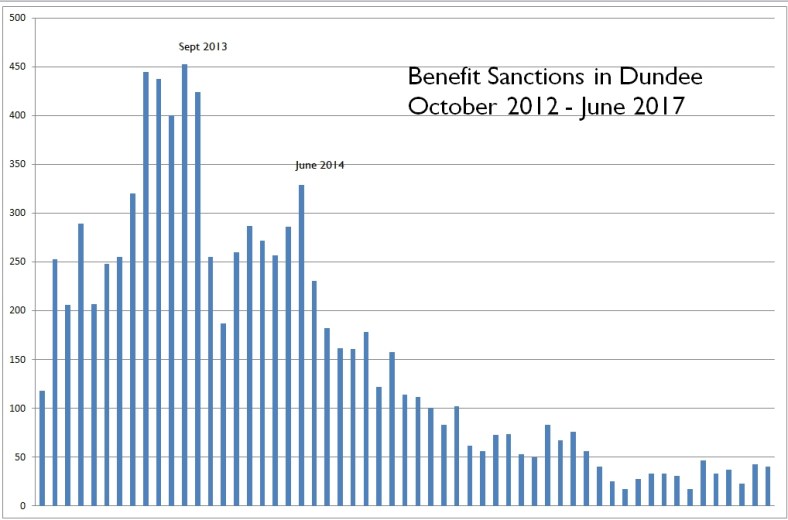
Last week the Dundee Courier published a big article proclaiming Dundee still ‘Sanctions City’. We have nothing but criticism for the sanctions system, but this headline is both misleading and unhelpful. Dundee jobcentre still has the highest number of sanctions of any jobcentre in Scotland, but it also has significantly more people signing on than any other Scottish jobcentre, so this is to be expected. What this headline obscures is the huge drop in the number of sanctions since 2013/14, as this graph shows.

17-11-18 Benefit sanctions by month

Being sanctioned is brutal, and is even worse for people on Universal Credit, when Hardship Payments become loans that have to be paid back off future benefits. But fear of sanctions is also a major cause of distress, so it is very important not to make people think that the risk is greater than it actually is!

We should also not ignore the drop in sanctions because it suggests that even the DWP can feel the pressure to respond to widespread outrage and campaigns: although, as we have discussed in the past, they may also have concluded that the fear of sanctions is enough to keep benefit claimants constantly on their toes, and they only need to implement enough actual sanctions to keep that fear alive.

We need to be careful, too, not to allow the focus on sanctions to obscure the many other ways that the DWP has devised to put pressure on people claiming benefits. As sanction numbers have fallen, so the number of people we have had to help because they have been refused disability benefits has gone up, and the foodbanks are being kept busy ensuring people survive benefit delays, but perhaps that doesn’t make such a snappy headline. There’s so very much to be concerned about; but exaggerating the probability of sanctions through lazy statistics is only feeding the DWP fear factory.


No winners in the game of welfare roulette

vegas

John was absolutely fizzing when we met him on a bitterly cold Monday morning outside Dundee buroo. He didn’t want to be there, would much rather have been at work, but is being forced into the hands of the DWP due to his failing health. Back in 2003, John, who is fifty one, had suffered three heart attacks in just two days. As a result, his life had been turned upside down. The necessity of letting his body recover meant that he had been remained away from work for over a year. And, whilst he had been able to return to paid employment, as a maintenance engineer, the effort required to get through a working week was becoming increasingly difficult to sustain. He was eventually forced to bow to the inevitable and started signing on in March this year. Despite the fact that John was forced to stop work due to increasing health issues, and had a history of poor health, he was advised to claim JSA and not ESA, and was informed that he should expect a text inviting him to a meeting to discuss his claimant commitment. When the text did arrive, however, he was surprised, indeed horrified, to learn that the scheduled meeting, for which he had received two days advance notification,  was due to take place in Southend-on-Sea.

John, who was now in a state of mounting panic, phoned the DWP and laid bare his dilemma. The adviser on the other end of the phone asked him, pointedly, ‘are you refusing to go?’ He confirmed that he was indeed refusing to attend and explained why, all over again. It appeared, however, that the geography of the (dis)United Kingdom was not the advisor’s strong point, and it took another four or five very long, expensive and often frustrating phone calls, before the situation was eventually resolved – John’s meeting was re-scheduled to take place at Dundee buroo and he was advised to apply for ESA.

When we met him, was palpably stressed out because his ESA payment was late and he was subsisting on his PIP money, of around £55pw.  The serious stress that he had experienced back in March had returned with a vengeance, and he was also suffering a recurrence and worsening of a long-term problem with Carpal-Tunnel syndrome, a condition that is caused by constant pressure being exerted on the median nerve of the wrist, a legacy of a lifetime working with his hands.

This case, which is now being dealt with by a housing association welfare advisor, was, though, by no means the only administrative cock-up that we encountered. We also met Judith who had emerged from the buroo after unsuccessfully trying to sign on. She had earlier received a text asking her to attend a meeting at 11am, but when she turned up had been told by her ‘work coach’ that this was a mistake and that she had to return at 2.30pm. Needless to say, Judith was not best pleased to be messed about, and when she had enquired why this had occurred had been curtly informed that it was due to ‘problems with the system’.

At least the cock-up that Judith experienced did not affect her already pitiful JSA payments. Sye was not so lucky. Despite having been on ESA, due to serious depression, for six weeks he had still not received any money. He was desperate, and had come to the buroo to request a short term benefit advance (STBA), but because his ‘work coach’ was off on a course to train her in the even more devilish ways of Universal Credit, he was simply told to return next week when she would be back. We provided Sye with details of a welfare organisation that could help him, both with his case and with access to food parcels and a food bank, if necessary.

One of our final cases of the day was Gordon, who turned out to be in a similar position to Sye, as he had not received his latest JSA payment, but his work coach had phoned up Clydebank Escalation Dept, and the money had been deposited in his account before he even left the buroo.

This week’s cases underline the mounting problems that are being experienced by all those signing on in the wake of the roll out of Universal Credit (UC). Pressure is clearly mounting on a welfare system that is already sagging under the weight of its own internal contradictions, to the extent that it increasingly becoming a game of chance as to whether people have their claims properly dealt with  and their already miserable ‘benefits’ (sic) paid on time. This infernal game of ‘welfare roulette’ provides no ‘fortunes’ for those lucky winners who may have an understanding ‘work coach’ who will actually intervene when admin problems do occur. For those that don’t have even that help, the cost is often heavy and long-lasting. It is measured in days without enough food or no food at all, of increasing mental health problems as frustration gives way to despair, and increasing physical ill health. This is not a welfare system, but a murderous misery-driven meat grinder. It is not good enough, however, just to ‘rage against the machine’ – we need to disable it and replace it with real social security.